00At a glance
12 things the data says about habits
- 01
4.4x
more check-ins with one or two friends
1.5 days
alone
6.6 days
with 1-2 friends
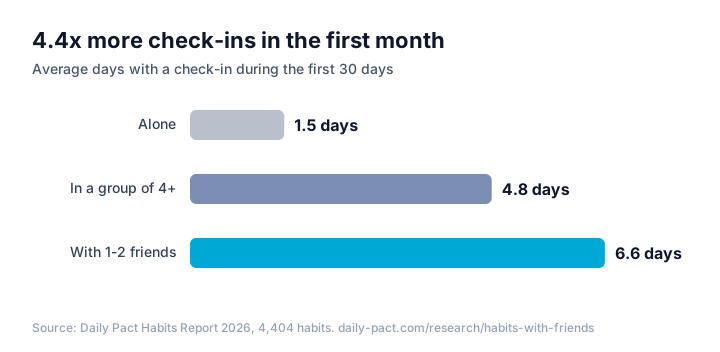
Habits shared with 1-2 friends got 6.6 check-in days in their first month. Habits done alone got 1.5.
- 02
54%
of solo habits never get one check-in
54% alone10% with othersStarted with others, only 10% never got going.
- 03
Day 1
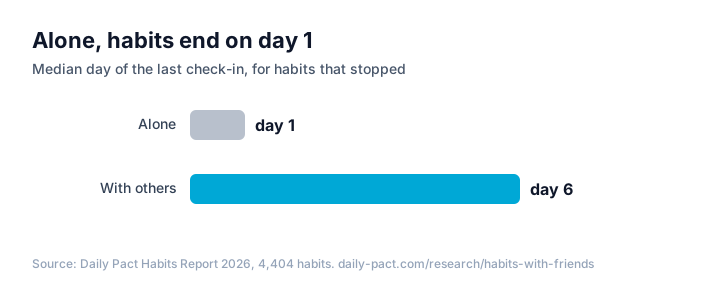
is when the typical solo habit stops
Aloneday 1With othersday 6With others, the typical last check-in comes on day 6.
- 04
86%
of habits that stop do it in two weeks
stopped by day 14of 2,555 habits that stoppedAlone or together, the first 14 days decide most habits.
- 05
4.6x
more habits alive after a friend's reaction
7%
no reaction
33%
a friend reacted
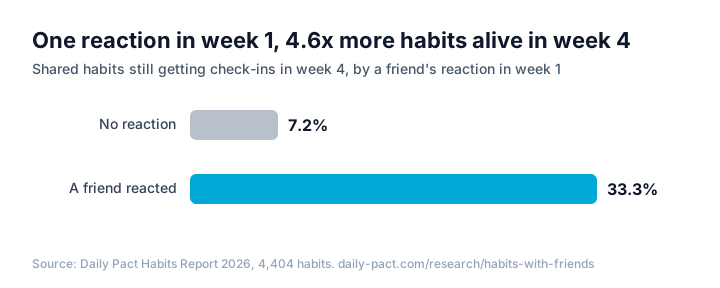
33% of shared habits were still going in week 4 when a friend reacted in week 1. Without a reaction: 7%.
- 06
3people
is the best group size
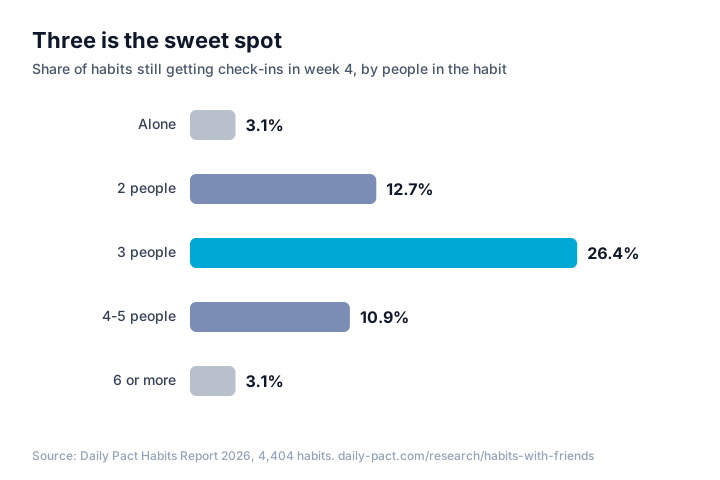
Alone3%2 people13%3 people26%4-5 people11%6 or more3%26% of habits shared by exactly three people were still going in week 4. Pairs: 13%. Groups of 6+: 3%, the same as alone.
- 07
15%
come back after two missed days
1 day missed28%2 days missed15%After one missed day, 28% of shared habits got a check-in the next day. After two in a row, 15%.
- 08
1 in 4
habits with friends reach a 7-day streak
26% with 1-2 friends, 6.6% alone. Only 0.2% of daily habits reach 66 days.
- 09
8pm
is the peak hour for check-ins
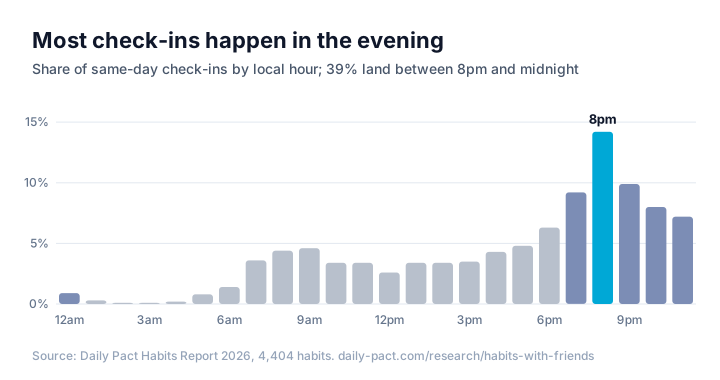
12am6am12pm6pm39% land between 8pm and midnight. 1 in 4 is logged the next morning.
- 10
2.6x
better when you start on the 1st
1st of a month17%Other days6.5%A Monday7.1%17% of habits started on the 1st of a month were alive in week 4, against 6.5%. Mondays gave no edge.
- 11
0
difference from reminders on their own
Reminder set7.9%No reminder7.7%Habits with a reminder: 7.9% alive in week 4. Without: 7.7%. People move the numbers, notifications don't.
- 12
91%
of shared fitness habits start, vs 36% alone
36%
alone
91%
with others
Fitness is the most common habit (18%) and the one where company makes the biggest difference in week one.
01Starting
Half of solo habits never get a single check-in
The biggest drop happens before a habit even starts. 54% of habits started alone never got one check-in, against 10% of habits started with others.
Habits that never got a single check-in
n = 1,615 solo and 2,789 shared habits.
Got a check-in in the first week
43%
alone
89%
with others
Of solo habits that stopped, 45% never got past the day they were created. A habit that survives a few extra days gets more chances to become routine.
The typical last check-in, for habits that stopped (median day after starting)
Alone: day 1
With others: day 6
2,555 habits with no check-in in the last 21 days (516 solo, 2,039 shared).
See the numbers+
| Alone | With others | |
|---|---|---|
| Median day of last check-in | day 1 | day 6 |
| Stopped on day 0 | 44.6% | 11.4% |
| Stopped in week 1 | 72.1% | 50.2% |
| Stopped by day 14 | 89.1% | 85.2% |
| Stopped by day 30 | 95.9% | 95.9% |
02The first two weeks
The first two weeks decide it
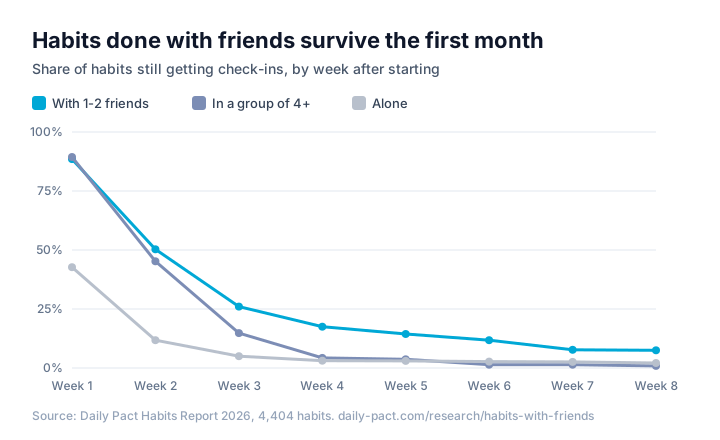
Most habits don't fade slowly. 86% of the habits that stopped got their last check-in within two weeks. In week 2, half of the habits shared with 1-2 friends were still getting check-ins (50%), four times the rate for habits done alone (12%).
Share of habits still getting check-ins, by week after starting
Each week only counts habits old enough to have reached it. n = 1,210 habits with 1-2 friends, 1,579 in groups of 4+, 1,615 alone.
See the numbers+
| Week | With 1-2 friends | Group of 4+ | Alone |
|---|---|---|---|
| Week 1 | 88.5% | 89.4% | 42.7% |
| Week 2 | 50.3% | 45.2% | 11.8% |
| Week 3 | 26% | 14.8% | 5% |
| Week 4 | 17.5% | 4.3% | 3.1% |
| Week 5 | 14.4% | 3.7% | 3% |
| Week 6 | 11.8% | 1.4% | 2.7% |
| Week 7 | 7.7% | 1.4% | 2.6% |
| Week 8 | 7.5% | 0.9% | 2.1% |
That lines up with January. Strava put the resolution cliff in the second week of the year and called it Quitter's Day. Our numbers say the cheapest way over it is not more willpower but one other person who notices. Long term, most habits fade in every group: by week 8, 7.5% of habits shared with 1-2 friends were still active, against 2.1% alone.
03Group size
Three is the sweet spot
Habits shared by exactly three people did best: 26.4% were still getting check-ins in week 4. Past five people the effect disappears: groups of six or more ended week 4 at the same 3.1% as people on their own.
Still getting check-ins in week 4, by people in the habit
Alone
3.1%
2 people
12.7%
3 people
26.4%
4-5 people
10.9%
6 or more
3.1%
See the numbers+
| People | Habits (n) | Alive in week 4 | Check-in days, month 1 |
|---|---|---|---|
| Alone | 1,615 | 3.1% | 1.5 |
| 2 people | 766 | 12.7% | 5.4 |
| 3 people | 444 | 26.4% | 8.9 |
| 4-5 people | 236 | 10.9% | 4.7 |
| 6 or more | 1,343 | 3.1% | 4.8 |
Check-in days in the first 30 days
Alone
1.5
2 people
5.4
3 people
8.9
4-5 people
4.7
6 or more
4.8
Habits at least 30 days old: 1,116 / 669 / 367 / 218 / 1,174.
In a pact of two or three, one person going quiet is obvious. In a group of ten, nobody notices, and everybody knows nobody notices. If you're setting up an accountability group, keep it small.
Start a pact of three
Daily Pact is built around this: one habit, one tap a day, and the two people in your pact see when you've done it.
04Being noticed
One reaction from a friend changes the month
Among shared habits, 33.3% were still going in week 4 when a friend had reacted to a check-in in the first week, against 7.2% when nobody did.
Shared habits alive in week 4
7.2%
no reaction in week 1
33.3%
a friend reacted
n = 357 shared habits with a reaction in week 1, 2,432 without.
Check-in days in the first month
4.9 days
no reaction
11 days
a friend reacted
Habits at least 30 days old: 251 with a reaction, 2,177 without.
Part of this runs the other way: active habits get seen, and seen habits get reactions. But it matches what people tell us. Being in a group is not the same as being noticed, and a two-second emoji is the cheapest form of noticing there is.
05Missed days
Miss one day, fine. Miss two, and most habits end
After a single missed day, 28% of shared habits got a check-in the very next day. After two missed days in a row, only 15% came back. “Never miss twice” is good advice, and the data backs it (more in never miss twice).
Chance of a check-in after a missed day (daily habits)
With others
Back next day
28%
Back within a week
53%
After 2 misses
15%
Alone
Back next day
19%
Back within a week
40%
After 2 misses
10%
n = 4,339 missed days in shared daily habits, 975 in solo ones.
06Streaks
1 in 4 habits with friends reaches a 7-day streak
26% of daily habits shared with 1-2 friends reached 7 days in a row, against 6.6% alone. Long streaks are rare everywhere: only 0.2% of daily habits reached 66 days, the median time to automaticity in the best-known habit formation study.
Share of daily habits that reached each streak length
3 days
7 days
14 days
30 days
Daily habits with at least one check-in: 883 with 1-2 friends, 651 alone.
See the numbers+
| Streak | With 1-2 friends | Alone |
|---|---|---|
| 3 days | 56.9% | 19.5% |
| 7 days | 26.2% | 6.6% |
| 14 days | 9.3% | 0.8% |
| 30 days | 2.8% | 0.2% |
07Time of day
Habits are an evening thing: 8pm is the peak
8pm is the busiest hour for check-ins (14% of all same-day check-ins), and 39% land between 8pm and midnight. Only 12% happen before 9am, and one in four (26%) is logged the next day.
Share of same-day check-ins by local hour
n = 18,442 check-ins made on the day itself, in the person's time zone.
See the numbers+
| Hour | Share |
|---|---|
| 12am | 0.9% |
| 1am | 0.3% |
| 2am | 0.1% |
| 3am | 0.1% |
| 4am | 0.2% |
| 5am | 0.8% |
| 6am | 1.4% |
| 7am | 3.6% |
| 8am | 4.4% |
| 9am | 4.6% |
| 10am | 3.4% |
| 11am | 3.4% |
| 12pm | 2.6% |
| 1pm | 3.4% |
| 2pm | 3.4% |
| 3pm | 3.5% |
| 4pm | 4.3% |
| 5pm | 4.8% |
| 6pm | 6.3% |
| 7pm | 9.2% |
| 8pm | 14.2% |
| 9pm | 9.9% |
| 10pm | 8% |
| 11pm | 7.2% |
The evening is when people take stock of the day. A short, fixed check-in at the end of the day is easier to keep than one you have to remember mid-morning.
08Weekdays
Tuesday is the busiest day, Friday the quietest
Half of all check-ins happen Monday to Wednesday. If a habit is going to slip, it slips from Thursday on, so the end of the week is where a check-in with your partner earns its keep.
Share of check-ins by weekday, last 180 days
09Start day
Start on the 1st, not on a Monday
Habits started on the 1st of a month were 2.6 times as likely to still be going in week 4 (17.0% vs 6.5%). Starting on a Monday made no difference (7.1% vs 7.9%).
Alive in week 4, by start day
1st of a month
17.0%
Any other day
6.5%
A Monday
7.1%
Not a Monday
7.9%
n = 450 habits started on the 1st, 729 on a Monday.
Check-in days in the first month
4.0 days
other days
6.6 days
started on the 1st
The 1st comes with a finish line. People who start then are often doing a 30-day challenge or a monthly challenge with friends. More in the fresh start effect.
10Habit types
What people try to build, and where friends help most
Fitness is the most common habit (18%), then food and diet (16%), walking and running (7%), reading and learning (6%), sleep and mindfulness (5%) and water (5%). The gap between alone and together shows up in every type, and it is widest for fitness.
Got a check-in in the first week: alone vs with others
Fitness and gym · 18% of habits
Walking and running · 7% of habits
Reading and learning · 6% of habits
Sleep, meditation, journaling · 5% of habits
Drinking water · 5% of habits
Gold: with others. Grey: alone. Types come from keywords in the habit name; types with fewer than 100 habits on either side are left out (food and quitting habits are mostly shared).
Ideas for each: fitness challenges with friends, a no sugar challenge and study habits.
11Goals and reminders
A few times a week outlasts every day. Reminders change nothing
Alive in week 4, by goal
7.1%
every day
11.4%
a few times a week
A daily habit breaks the first time life gets in the way. A three-times-a-week habit has room for a bad day.
n = 3,784 daily and 620 weekly-target habits.
Alive in week 4, with and without a reminder
7.7%
no reminder
7.9%
reminder set
12% of habits had a reminder. A notification is easy to swipe away. A friend waiting on your check-in is not.
n = 520 habits with a reminder, 3,884 without.
12Who is in the data
1,605 people in 86 countries
Share of habits by country (top 10)
United States
37.3%
United Kingdom
11.4%
Nigeria
9.5%
Germany
4.6%
Canada
4%
Australia
3.9%
Brazil
3.2%
India
2.2%
Mexico
2.1%
Sweden
1.8%
The app is available in 21 languages.
13What to do with this
Six rules the data supports
- 1
Pick two people, not a crowd.
Three in total is the size where everyone notices.
- 2
Start on the 1st, with an end date.
A month is easier to finish than “from now on”.
- 3
Plan for week two.
Starting is easy with company. The drop comes in days 7 to 14.
- 4
React to your friends' check-ins.
It takes two seconds and goes with 4.6x as many habits alive in week 4.
- 5
Never miss twice.
One missed day is normal. Get back on the next day.
- 6
Check in at night.
Most people take stock around 8pm. Make that your moment.
More on setting this up: how to start an accountability group, what an accountability partner does and accountability apps for ADHD.
14FAQ
Questions people ask about habits
How long does it take to form a habit?+
The best-known study (Lally et al., 2010) found a median of 66 days, with a range of 18 to 254. Our data shows why most people never find out: only 0.2% of daily habits in Daily Pact reached a 66-day streak, and 86% of habits that stopped did so within two weeks. Getting through the first 14 days matters more than the exact number. How long it takes to form a habit
Do accountability partners actually work?+
In our data, habits shared with one or two friends got 6.6 check-in days in the first month against 1.5 for habits done alone, and 17.5% were still going in week 4 against 3.1%. This is app data, not a trial, so part of the gap is who chooses to invite a friend. But the gap is large and shows up from the first week. Accountability partners: the data
What is the best size for an accountability group?+
Three people. Habits shared by exactly three people had the highest week-4 survival (26.4%), then pairs (12.7%) and groups of 4-5 (10.9%). Groups of six or more faded to the same level as people alone (3.1%): in a big group, one person going quiet is easy to miss. How to start an accountability group
When do most people give up on a new habit?+
Early. The typical solo habit that stops gets its last check-in on day 1, and 45% of stopped solo habits never got past the first day. With others, the typical last check-in is day 6. Across everyone, 86% of habits that stopped did so in the first two weeks, which matches the Quitter's Day pattern in January. Quitter's Day
What is the best day to start a new habit?+
The 1st of a month did better than any weekday in our data: 17% of habits started on the 1st were alive in week 4, against 6.5% started on other days. Starting on a Monday gave no advantage (7.1% vs 7.9%). A month gives a clear finish line, which a Monday doesn't. The fresh start effect
Does missing one day ruin a habit?+
No, but missing two usually does. After a single missed day, 28% of shared habits and 19% of solo habits got a check-in the very next day, and about half came back within a week. After two missed days in a row, only 15% and 10% came back the next day. Never miss twice
Do habit reminders help?+
Not on their own. Habits with a reminder set had the same week-4 survival (7.9%) as habits without one (7.7%). What moved the numbers was other people: a friend in the habit, and a friend reacting to a check-in in the first week.
What time of day do people check in on their habits?+
Mostly in the evening. 8pm is the busiest hour (14% of same-day check-ins), 39% land between 8pm and midnight, and only 12% happen before 9am. One in four check-ins is logged the next day, usually first thing in the morning.
15Method
How we measured
Data. Every habit joined in Daily Pact between March 4 and November 5, 2026: 4,404 habits (one person doing one habit) by 1,605 people, with 20,753 check-ins. Test, staff, guest and complimentary accounts are excluded. We only publish aggregates; no individual data is shared. Groups smaller than 100 are not reported.
Definitions. “With others” means the habit has at least two participants; “with 1-2 friends” means two or three in total. Day 0 is the day the person joined the habit, and week 1 is days 0 to 6. A habit is active in a week if it got at least one check-in that week, and each week only counts habits old enough to have reached it. “Stopped” means no check-in in the last 21 days. Streaks are consecutive days with a check-in, for daily habits. Check-in hours use the person's time zone and only count check-ins made on the day itself. Habit types come from keywords in the habit name. A reaction counts when someone else reacted to a check-in from the first 7 days.
Limits. This is app data, not a controlled trial. People who invite friends, react, or start on the 1st may be more motivated to begin with, so read every gap as an association, not proof of cause. Group size is measured today, not at the start, and people in the same group are not independent of each other. Most of our users are in their first months, so long-term numbers are small.
Earlier snapshot. The first version of this page (October 11, 2026, 3,723 habits) reported 5.9 check-in days in the first month with 1-2 friends against 1.7 alone, and a typical solo last check-in on day 3. Articles quoting those figures refer to that snapshot. We update the report as the data grows.
Use this data
Cite it, embed the charts
Cite this
Daily Pact (2026). The Daily Pact Habits Report 2026. Updated November 5, 2026. https://daily-pact.com/research/habits-with-friends
Free to use under CC BY 4.0 with a link to this page. Journalists and researchers: more cuts of the data, interviews and the press kit are available at info@guttae.se. Written by Alexander Lindgren, founder of Daily Pact.
Charts for your site (SVG, light background)
Habits done with friends survive the first monthSVG
<a href="https://daily-pact.com/research/habits-with-friends"><img src="https://daily-pact.com/research/habit-survival-by-week.svg" alt="Habits done with friends survive the first month" width="720" style="max-width:100%;height:auto"></a>
<p>Source: <a href="https://daily-pact.com/research/habits-with-friends">The Daily Pact Habits Report 2026</a></p>
Three is the sweet spot for habit groupsSVG
<a href="https://daily-pact.com/research/habits-with-friends"><img src="https://daily-pact.com/research/group-size-week-4.svg" alt="Three is the sweet spot for habit groups" width="720" style="max-width:100%;height:auto"></a>
<p>Source: <a href="https://daily-pact.com/research/habits-with-friends">The Daily Pact Habits Report 2026</a></p>
4.4x more check-ins in the first month with 1-2 friendsSVG
<a href="https://daily-pact.com/research/habits-with-friends"><img src="https://daily-pact.com/research/checkin-days-first-month.svg" alt="4.4x more check-ins in the first month with 1-2 friends" width="720" style="max-width:100%;height:auto"></a>
<p>Source: <a href="https://daily-pact.com/research/habits-with-friends">The Daily Pact Habits Report 2026</a></p>
A friend's reaction in week 1 and habits alive in week 4SVG
<a href="https://daily-pact.com/research/habits-with-friends"><img src="https://daily-pact.com/research/friend-reaction-week-4.svg" alt="A friend's reaction in week 1 and habits alive in week 4" width="720" style="max-width:100%;height:auto"></a>
<p>Source: <a href="https://daily-pact.com/research/habits-with-friends">The Daily Pact Habits Report 2026</a></p>
Alone, habits end on day 1SVG
<a href="https://daily-pact.com/research/habits-with-friends"><img src="https://daily-pact.com/research/quit-day.svg" alt="Alone, habits end on day 1" width="720" style="max-width:100%;height:auto"></a>
<p>Source: <a href="https://daily-pact.com/research/habits-with-friends">The Daily Pact Habits Report 2026</a></p>
Most habit check-ins happen in the eveningSVG
<a href="https://daily-pact.com/research/habits-with-friends"><img src="https://daily-pact.com/research/checkin-hour.svg" alt="Most habit check-ins happen in the evening" width="720" style="max-width:100%;height:auto"></a>
<p>Source: <a href="https://daily-pact.com/research/habits-with-friends">The Daily Pact Habits Report 2026</a></p>

Start a pact with two friends
Start your 14-day free trial. No credit card required.
5.0 from 13 App Store ratingsAvailable on iPhone & Android · 14 days free for new accounts