
Quitter's Day is the second Friday of January, the day New Year's resolutions are said to be most likely to stall. In 2027, Quitter's Day falls on Friday January 8. The name comes from Strava, the fitness app, which looked at its users' activity data and found that motivation for new exercise habits tended to drop off around that point in the month.

Ready to build habits with friends?
Start your 14-day free trial. No credit card required.
Our own app data puts the danger zone even earlier. In the Daily Pact Habits Report 2026 (4,404 habits), the typical solo habit that stopped got its last check-in on day 1, against day 6 for habits done with others, and 86% of habits that stopped did so within two weeks (Daily Pact Habits Report 2026). Quitter's Day is the moment the slide becomes visible, not where it starts.
6days
Median last check-in for habits done with others. Alone it was day 1.
86%
Of habits that stopped got their last check-in within two weeks of starting.
2.6x
Habits started on the 1st of a month were 2.6 times as likely to still be going in week 4.
This guide explains where Quitter's Day comes from, why the second week of January is genuinely hard, what research says actually helps, and a simple plan for January 4 to 10 so the day passes without incident.
What is Quitter's Day?
Quitter's Day (sometimes called quitting day) is the date in January when people are most likely to give up on their resolutions.
The term was popularized by Strava in January 2018. Strava looked at the activity its users logged after New Year and named the second Friday of January, which was January 12 that year, as the day people were most likely to lose motivation. Strava has repeated the analysis in later years and the exact date has moved, but it has stayed in the same mid-January window.
Two things are worth saying clearly:
- It's based on fitness data. Strava's analysis looked at exercise activity, not at diets, savings goals or Dry January. The idea has spread to resolutions in general because the pattern feels familiar.
- It's a pattern, not a law. Nobody is fated to quit on January 8. The useful part of Quitter's Day is the warning: week two is when it gets hard, so plan for it.
Quitter's Day dates
| Year | Second Friday of January |
|---|---|
| 2026 | January 9 |
| 2027 | January 8 |
| 2028 | January 14 |
New Year's resolution statistics: when people actually quit
Most new habits don't fail in week two. They fail in the first few days, and week two is when people notice. Among habits in our app that stopped, solo habits got their median last check-in on day 1 and shared habits on day 6. 44.6% of solo habits that stopped never got past day 0, against 11.4% of shared ones.
Alone: day 1
With others: day 6
Median day after starting. n = 2,555 habits with no check-in in the last 21 days (516 solo, 2,039 shared). Source: The Daily Pact Habits Report 2026.
See the numbers+
| Alone | With others | |
|---|---|---|
| Median day of last check-in | day 1 | day 6 |
| Stopped on day 0 | 44.6% | 11.4% |
| Stopped in week 1 | 72.1% | 50.2% |
| Stopped by day 14 | 89.1% | 85.2% |
| Stopped by day 30 | 95.9% | 95.9% |
By day 14, 89.1% of solo habits and 85.2% of shared habits that stopped had already had their last check-in. By day 30 it was 95.9% for both. In other words, the first two weeks decide most habits, alone or not, but people with a friend last noticeably longer inside that window.
The bigger difference shows up in who is still going a month in. In week 4, 17.5% of habits shared with one or two friends still got check-ins, against 3.1% of habits done alone. In week 2, the gap was 50.3% against 11.8%.
Each week only counts habits old enough to have reached it. n = 1,210 habits with 1-2 friends, 1,579 in groups of 4+, 1,615 alone. Source: The Daily Pact Habits Report 2026.
See the numbers+
| Week | With 1-2 friends | Group of 4+ | Alone |
|---|---|---|---|
| Week 1 | 88.5% | 89.4% | 42.7% |
| Week 2 | 50.3% | 45.2% | 11.8% |
| Week 3 | 26% | 14.8% | 5% |
| Week 4 | 17.5% | 4.3% | 3.1% |
| Week 5 | 14.4% | 3.7% | 3% |
| Week 6 | 11.8% | 1.4% | 2.7% |
| Week 7 | 7.7% | 1.4% | 2.6% |
| Week 8 | 7.5% | 0.9% | 2.1% |
These numbers describe people using a habit app, not every resolution, and they show association, not cause: people who invite a friend may also be more committed to begin with. The pattern is still useful. If you want to be in the group that is still checking in on Quitter's Day, the first week is where to put your effort.
Common New Year's resolutions
The most common resolutions in most surveys are some version of exercise more, eat better, save money, read more, sleep better and drink less. In our app the same themes lead: fitness and gym habits are 18% of all habits, walking and running 7%, reading and learning 6%, and sleep, meditation and journaling 5%. Fitness habits are also where a partner shows up most clearly: 90.6% of shared fitness habits got a check-in in their first week, against 36.4% alone. For ideas that fit a tired Tuesday, see our New Year's resolution ideas.
Why resolutions stall in week two
Nothing dramatic happens on Quitter's Day. That's exactly the problem. Resolutions don't usually end with a decision. They end with a missed day that turns into two, then a week, and then nobody mentions it again.
Week two is when several things line up:
- The fresh start fades. Researchers Hengchen Dai, Katherine Milkman and Jason Riis (2014) described the fresh start effect: people are more likely to start working on goals after temporal landmarks like a new year, a new month or a Monday. January 1 is the biggest landmark of all. By the second week it's behind you, and so is that boost.
- Normal life returns. The holidays are over. Work, school and family routines come back with full force, and the new habit has to compete with all of them.
- The goal was too big. Resolutions set on New Year's Eve often describe who we'd like to be, not what we can do on a tired Tuesday. By week two, the gap shows.
- Nobody would notice. Most resolutions are private. If you stop on a Friday, there's no one to ask on Saturday what happened.
- Friday is Friday. The end of the first full working week of the year is a natural moment to tell yourself you've earned a night off. One night off is fine. The trouble is when it doesn't end.
What research says keeps people going
Some reassurance first: resolutions are not pointless. In a study by John Norcross and colleagues (2002), 46% of people who made New Year's resolutions were still on track six months later. Among people with similar goals who didn't make a resolution, Norcross has said only 4% were successful. Making the resolution helps. The question is how to keep it.
Here's what the research supports:
Add something, rather than only stopping something. A 2020 study of more than 1,000 people led by Martin Oscarsson at Stockholm University found that people with approach-oriented goals ("start running", "eat vegetables at lunch") were more successful than those with avoidance goals ("stop eating sweets"). If your resolution is about quitting something, add a replacement behavior.
Make an if-then plan. Psychologist Peter Gollwitzer's "implementation intentions" are plans in the form "If it's 7am on a weekday, then I'll walk for 20 minutes." A 2006 meta-analysis by Gollwitzer and Paschal Sheeran found these plans had a medium-to-large effect on reaching goals. A time and a place beat good intentions.
Start on a landmark day. The fresh start is real in our data too. Habits started on the 1st of a month were 2.6 times as likely to still be going in week 4 as habits started on any other day (17.0% vs 6.5%). Starting on a Monday made no difference (7.1% vs 7.9% for other days). January 1 is the biggest 1st of the year, so use it, and plan for the boost to wear off.
1st of a month
17.0%
Any other day
6.5%
A Monday
7.1%
Not a Monday
7.9%
n = 450 habits started on the 1st of a month, 729 on a Monday. Source: The Daily Pact Habits Report 2026.
Expect to miss a day, and don't treat it as failure. In the best-known study of habit formation, Phillippa Lally and colleagues at University College London (2010) found that a new daily habit took a median of 66 days to feel automatic, with a range of 18 to 254 days. Missing a single day did not meaningfully affect the process. Quitter's Day is dangerous because people treat one miss as the end.
Do it with someone. In a 1999 study by Rena Wing and Robert Jeffery, people who joined a weight-loss program with friends and got social support were more likely to finish (95% vs 76%) and to keep the weight off at ten months (66% vs 24%) than those who joined alone. Strava's own 2018 analysis made a similar point: it reported that people who trained with others were more active than those who trained alone.
The thread through all of these: small, specific, forgiving and shared beats big, vague, perfect and private.
Your Quitter's Day plan: January 4 to 10, 2027
Week two of 2027 runs from Monday January 4 to Sunday January 10, with Quitter's Day in the middle. Here's a plan that works for almost any resolution.
| Day | Date | What to do |
|---|---|---|
| Mon | Jan 4 | Shrink the goal. Write down the smallest version of your resolution you could do on your worst day. That's your floor for the week. |
| Tue | Jan 5 | Write your if-then plan. "If it's [time] and I'm [place], then I'll [habit]." Put it in your calendar. |
| Wed | Jan 6 | Tell one person. Not social media. One friend, partner or coworker. Ask them to check in with you on Friday. |
| Thu | Jan 7 | Plan Friday tonight. Decide exactly when you'll do the habit tomorrow, and what you'll do if the evening goes off script. |
| Fri | Jan 8 | Quitter's Day. Do the floor version. Not the full workout, not the perfect day. Just the minimum, then tell your friend you did it. |
| Sat | Jan 9 | Look back on week one. Count the days you showed up since January 1. Missing one or two is normal, not failure. |
| Sun | Jan 10 | Set up week three. Monday January 11 is a fresh start too. Adjust the plan: smaller, a different time, or a different habit if this one doesn't fit. |
If you miss a day in the middle of all this, the rule is simple: never miss twice. One missed day is life. Two in a row is how the quiet quitting starts.
Two of these steps get easier in an app built for it (see our resolution tracker comparison for the options). On Thursday, add a second daily reminder for Friday's backup time, so the evening catches what the morning missed. On Saturday, you don't have to count: your streak and completion rate are already there.
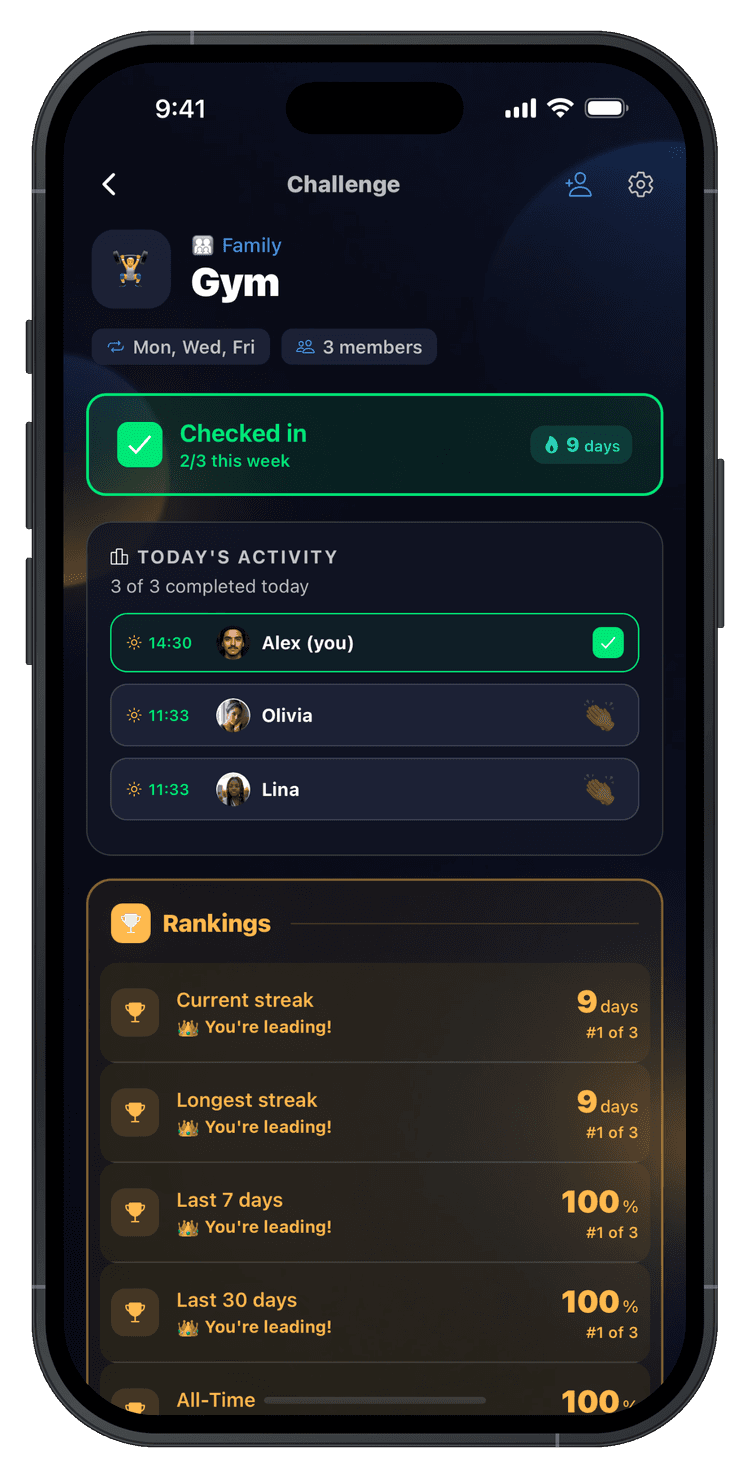
How to get past Quitter's Day with a friend
The most reliable part of the plan is Wednesday: telling someone. A resolution someone else can see is much harder to drop without a word.
You don't need a formal setup. A friend who texts "did you do it?" is enough. The catch is that by week two, the texts usually stop too. That's what Daily Pact is for: you and a friend (or a small group) pick one daily habit, each of you checks in with one tap, and you both see who showed up, without anyone having to remember to ask.
Our campaign for 2027 is the January Pact: one small habit and one friend, checked in every day from January 1 to 31. The line is "don't quit alone", and Quitter's Day is the reason.
For more on picking the right person, see our guide to finding an accountabilibuddy. For the long view on keeping resolutions past January, read how to keep New Year's resolutions.
What if you've already quit?
Then you're in good company, and nothing is lost. Habits are built across weeks and months, not in one perfect streak. Pick the smallest version of your goal and start again on the next Monday, or the first of February. Both are fresh starts.
If it's your friend who went quiet, don't wait for them to bring it up. A nudge in your pact, or a "want to restart Monday?", is a kind way back in. Restarting is much easier when someone else asks first.
If the problem was the goal itself, pick a different one. Our New Year's resolution ideas and goals for the new year have plenty of smaller, more doable options.
Frequently asked questions
When is Quitter's Day 2027?
Friday January 8, 2027. Quitter's Day is the second Friday of January.
Who came up with Quitter's Day?
Strava, the fitness app and social network for athletes. In January 2018 it analyzed its users' activity data and named the second Friday of January as the day people were most likely to give up on new fitness habits.
Is Quitter's Day real?
It's based on real activity data from Strava, but it's a pattern, not a deadline. The more useful takeaway is that the second week of January is when motivation commonly dips, so it's worth having a plan, or a workout motivation app that brings a friend in.
What is the difference between Quitter's Day and quitting day?
They mean the same thing. Quitter's Day is the more common name for the second Friday of January.
When do most people quit their New Year's resolutions?
Earlier than Quitter's Day. In the Daily Pact Habits Report 2026, the typical solo habit that stopped got its last check-in on day 1, and habits done with others on day 6. 86% of habits that stopped did so within two weeks. See the full report.
Does starting a resolution on January 1 help?
In our data, yes. Habits started on the 1st of a month were 2.6 times as likely to still be going in week 4 as habits started on other days. More in the fresh start effect.
How do I avoid quitting my New Year's resolution?
Make the goal small and specific, set a time and place for it, expect to miss a day without treating it as failure, and do it with at least one other person who will notice if you stop.
Ready to build habits with friends?
Start your 14-day free trial. No credit card required.