
Good monthly challenges are one small daily action with a yes or no answer, done for a whole month: Dry January in January, 20 minutes of movement in February, a no-spend month in August, written gratitude in November. Below is one monthly challenge idea for every month of the year, chosen to work with the season instead of against it.
A month is close to the right length for a challenge. Long enough that finishing means something, short enough that you can see the end from the start. That's the part a vague "I'm going to get fitter this year" never gives you. And trying to start a 6am running habit in January in the dark is not discipline, it's bad scheduling.

Monthly challenge ideas at a glance
| Month | Challenge | Daily rule |
|---|---|---|
| January | Dry January, or any subtraction | No alcohol (or no takeaways, no phone in bed) |
| February | 28 days of movement | 20 minutes, walking counts |
| March | The morning hour | First hour without the phone |
| April | Spring clear-out | One item leaves the house |
| May | Outside every day | 20 minutes outdoors |
| June | 10,000-step month | Hit the step target |
| July | Read every day | 20 pages or 15 minutes |
| August | No-spend month | Nothing in one chosen category |
| September | Back to routine | One fixed habit, like a set bedtime |
| October | 30 days of strength | Press-ups, squats, a plank |
| November | Gratitude, written down | Three things, in writing |
| December | Ten minutes of calm | Ten quiet minutes |
January: Dry January, or a quieter version
The obvious one, and it works because half the country is doing it at the same time. If alcohol isn't your thing, the January version of this is any subtraction: no takeaways, no phone in the bedroom, no doomscrolling before 9am.
Why it works in January: everyone else is also attempting something, so the social cost of taking part is zero. If you're going alcohol-free, Dry January with friends covers how to do it together, and the 30-day no alcohol challenge guide works in any month.
Doing this in January 2027?
January 1, 2027 is a Friday, and the second Friday, January 8, is what Strava calls Quitter's Day: the point where many resolutions quietly fade. Two things help you get past it. First, pick one small habit rather than a whole new life; our guide to goals for the new year helps you choose. Second, pick one friend to do it with before New Year's Eve. In Daily Pact you can start the pact now and invite them by name: they get their own link and a seat held for them, and if they still haven't joined by December 30 you can send a nudge instead of a third text. That's the whole idea behind the January challenge: one habit, one friend, every day from January 1 to 31. If you'd like it on paper too, there's a January 2027 sheet in our free habit tracker printable.
February: 28 days of movement
Short month, low bar. Twenty minutes of deliberate movement a day, walking included. February is grim and the goal is a floor you cannot fail, not a training block.
March: the morning hour
Light comes back. Claim the first hour: no phone, one useful thing. Reading, stretching, writing, whatever survives contact with a tired morning.
April: spring clear-out
One item leaves the house every day. Thirty items in a month, and unlike most challenges the evidence accumulates in plain view.
May: outside every day
Twenty minutes outdoors, daily, no exceptions for weather. The lowest-effort challenge here and reliably one of the most felt.
June: the 10,000-step month
Long days make this the easiest month of the year to hit a step target. Pair it with a friend and compare weekly totals rather than daily ones. Daily comparison gets discouraging fast when someone has a desk job.
July: read every day
Twenty pages, or fifteen minutes. Holidays make July unusually forgiving for a reading habit, and unusually hostile to anything requiring a gym. Reading the same book with a friend turns it into a buddy read, with someone waiting at each chapter.
August: no-spend month
Pick a category (eating out, clothes, subscriptions) and cut it for the month, or go all in with a full no spend challenge. Track every purchase you don't make. The number at the end is usually the motivating part.
September: back to routine
The real new year. September is when structure returns, which makes it the best month of the twelve to start something you intend to keep: a fixed bedtime, a training plan, a language.
October: 30 days of strength
Cold enough to be indoors, not yet December. Bodyweight is fine: press-ups, squats, a plank. Progressive, so week four is visibly harder than week one.
November: gratitude, written down
Three things a day, in writing. It sounds soft and it is the most consistently reported-effective thing on this list. November is dark and this is a deliberate counterweight.
December: ten minutes of calm
Do not attempt an ambitious challenge in December; you will lose and it will sour January. Ten minutes of quiet a day is achievable in the worst week of the year. If calm isn't your thing, there are 24 more in our December challenge ideas, from Advent calendars to a walk after every big meal. If you're travelling for the holidays and know you'll miss a few days, ask your group for a PactPause before you leave: they vote, and the paused days don't break your streak.
Monthly challenges like Dry January
Dry January works because it has a name, a fixed month and millions of people doing it at once. Several other monthly challenges copy that recipe. Joining one gives you a ready-made rule, a start date and a crowd, which is most of what keeps a monthly challenge going. These are the best-known ones:
| Month | Challenge | The rule |
|---|---|---|
| January | Dry January | No alcohol for the month (Alcohol Change UK) |
| January | Veganuary | Eat vegan for 31 days, running since 2014 |
| July | Plastic Free July | Cut single-use plastic for the month |
| October | Stoptober | Stop smoking: the NHS goal is 28 days smoke free, after which you're 5 times more likely to quit for good |
| November | Movember | Grow a moustache or take on a challenge to raise money for men's health |
Two tips if you join one. Do it with at least one friend you can see checking in, not just the hashtag: a crowd of strangers starts you, a friend gets you to day 20. And pick one rule, not three: Veganuary plus Dry January plus a gym streak in the same month is how all three end on January 9.
You can also invent your own named month with your group: "No-Scroll November", "Stairs September". A name and a start date are what make it feel like an event instead of a resolution.
Monthly challenge ideas for work
A team challenge needs two extra rules: opt in by invite link, never by roster, and keep it to a yes/no check-in so nobody shares health data. With that settled, these run well in an office or a remote team:
- Walk at lunch: 20 minutes, every workday
- No meetings before 10am: four days a week
- Inbox zero by end of day
- Log off by 6pm
- Take the stairs all day
- One learning session a week: a course, a talk, a book chapter
- Bring lunch three days a week
- A screen-free lunch
Our guide to team accountability apps covers what it costs for 10, 20 or 50 people and how to keep it voluntary. In Daily Pact, one person can cover the whole team so nobody else pays, and colleagues join from one link in Slack or Teams.
How long should a monthly challenge be?
The whole month, but with a rule agreed on day one about what a missed day means.
This matters more than the challenge you pick. Most people don't quit on the day they miss. They quit two or three days later, once the gap has quietly turned from an accident into a decision. Decide in advance: a miss costs you the day and nothing else. Groups that skip this step reliably fall apart in week two, every time.
Two other things that decide whether a monthly challenge survives:
- Make it binary. At the end of the day the answer has to be yes or no. "Read 20 pages" works. "Read more" doesn't, because on a bad day you'll negotiate with yourself and win.
- Make it visible to someone. A challenge nobody else can see is a promise you're free to renegotiate. This is the entire mechanism, and it's why the same challenge that dies alone survives in a group.
Running these with friends
Every challenge above works better with two or three other people doing the same one. Not for encouragement, but because someone notices.
You can run it from a group chat, and plenty do. It holds for about a week: check-ins get quieter, one person goes silent, everyone reads it as permission, and it ends without anyone announcing it. That exact failure is why we built Daily Pact: a private group, one shared challenge, one-tap check-in, and a leaderboard so being behind is visible without anyone having to bring it up. When you check in, your friends get a notification; when they check in, you do. Nobody has to post anything.
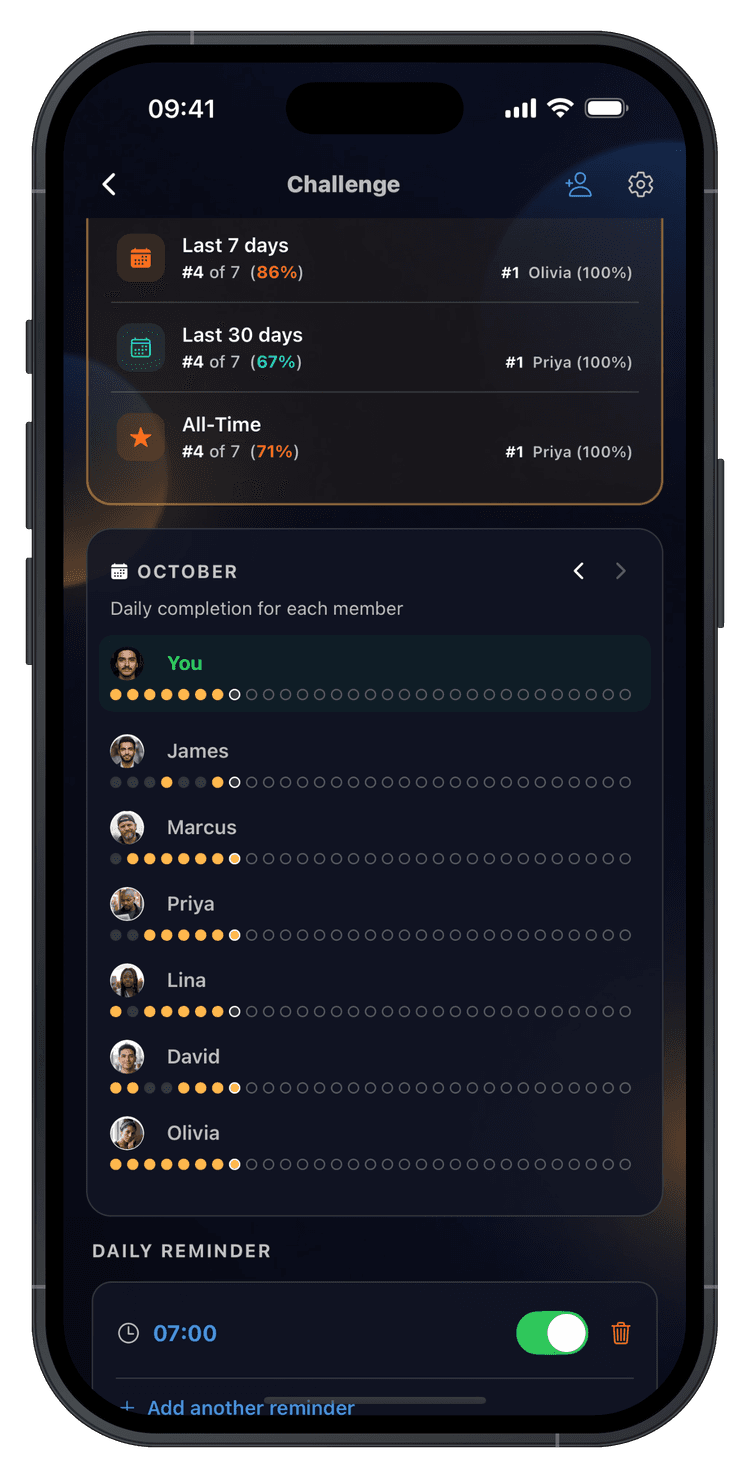
More ideas: daily challenges if a month feels long, 30-day challenge ideas for the full list, or self care challenges for the gentler end.
Frequently asked questions
What is a monthly challenge?
A monthly challenge is one daily action you commit to for a whole calendar month, like no alcohol in January or 20 pages of reading a day in July. The month gives it a clear start and finish, which makes it easier to stick to than an open-ended resolution.
What are some good monthly challenges?
Dry January, 20 minutes of daily movement, a no-spend month, reading every day, 10,000 steps a day and written gratitude are the most reliable. Pick one that fits the season and has a yes or no answer every day.
What monthly challenges are like Dry January?
Veganuary in January, Plastic Free July, Stoptober in October and Movember in November all work the same way: a named month, one rule and many people doing it at the same time.
How do you do a monthly challenge with friends?
Agree on one rule and one start date, decide on day one that a missed day costs the day and nothing else, and check in somewhere everyone can see. See how to start a 30 day challenge with friends.
Is a 30-day challenge the same as a monthly challenge?
Almost. A monthly challenge follows the calendar month, so everyone starts on the 1st. A 30-day challenge can start any day. For a group, the calendar month is easier because nobody has to remember when day one was.