January 2027 habit tracker Habit(s): ____________________________
Rule for a missed day (agree this before you miss one): ______________________________________
| Habit | F | S | S | M | T | W | T | F | S | S | M | T | W | T | F | S | S | M | T | W | T | F | S | S | M | T | W | T | F | S | S |
|---|---|---|---|---|---|---|---|---|---|---|---|---|---|---|---|---|---|---|---|---|---|---|---|---|---|---|---|---|---|---|---|
| January 2027 | 1 | 2 | 3 | 4 | 5 | 6 | 7 | 8 | 9 | 10 | 11 | 12 | 13 | 14 | 15 | 16 | 17 | 18 | 19 | 20 | 21 | 22 | 23 | 24 | 25 | 26 | 27 | 28 | 29 | 30 | 31 |
One habit per row. Tick the day you did it. Jan 8 (marked) is Quitter's Day, Strava's name for the second Friday of January, when many resolutions fade. Check in anyway, even if it's the smallest version of the habit.
daily-pact.com/tools/habit-tracker-printable
Which habit tracker template to print
Pick a tab above, press Print, and choose landscape. Each sheet fits one page on US Letter or A4. If you are starting on January 1, print the January sheet and the pact tracker, and keep the year at a glance for later.
January 2027 habit tracker
31 days with the weekdays already filled in (January 1, 2027 is a Friday), weekends shaded and Quitter's Day on January 8 marked. Five rows, so up to five habits, though one is better.
Monthly habit tracker
The same 31-day grid with no month printed on it. Write the month at the top and reuse it all year.
Pact tracker for two people
One habit, two names, 31 boxes each, a rule for missed days and a line for both of you to sign. This is the one we would print.
2027 year at a glance
Twelve rows, one per month, one box per day for a single habit. Days that don't exist (February 29 to 31, the 31st of short months) are shaded.
Weekly habit tracker
Eight habits across seven days with a weekly total. Good for trying a habit out before you commit to a month.
Accountability chart
One row per person and 14 days, for a family, class or team running the same challenge.
How to use a monthly habit tracker
- Write the habit as a yes-or-no action. "Walk 20 minutes" can be ticked. "Be healthier" can't, and on a tired evening you will argue yourself out of it.
- Write down the smallest version that still counts. Two minutes of stretching on the worst day keeps the row unbroken, and an unbroken row is what makes you want to keep going.
- Fill in the missed-day rule before day one. Most people don't quit on the day they miss. They quit two or three days later, once the gap has quietly turned into a decision. Ours is simple: a miss costs you that day and nothing else.
- Tick the box at the same moment every day. Tie it to something you already do, like brushing your teeth or switching off the kettle, so checking in becomes part of the routine itself.
- Count the month, then decide. At the end, add up the boxes and choose: keep the habit, make it a little bigger, or swap it. Then print next month's sheet.
One month will not make a habit automatic. In the best-known study on this, Lally et al. (2010) found it took a median of 66 days for a daily behavior to feel automatic, with a range of 18 to 254 days. A month is a good first stretch, which is why the 2027 year-at-a-glance sheet exists.
The pact tracker: a habit tracker for two
Most habit trackers assume you are doing this alone. The pact tracker doesn't. You and one friend pick one habit, write both names on the sheet, agree what the other person does when someone misses, and sign it. Stick it somewhere you both see it, or each print a copy and send each other a photo of the row at the end of the week.
If you live in different places, a weekly photo means you only find out on Sunday that your friend stopped on Tuesday. That gap is why I built Daily Pact: it's the same pact, but you see the moment your friend ticks their box, and they see yours.
Doing it with someone isn't just nicer. In a weight-loss study by Wing and Jeffery (1999), 95% of people who signed up with friends completed the program and 66% kept the weight off at 10 months, against 76% and 24% of those who signed up alone. Writing it down and signing it is the paper version of the same idea. If you want to go further, our accountability partner agreement covers what to agree on, and how to find an accountabilibuddy helps if you don't have someone in mind yet.
Habit ideas to track
Pick one that takes under 15 minutes and can be done at home. Small habits survive bad weeks; big ones get skipped and then quietly dropped.
Body
- Walk 20 minutes
- 10 push-ups before breakfast
- Drink a glass of water first thing
- Stretch for 5 minutes before bed
- In bed by 11pm
Mind
- Read 10 pages
- No phone for the first 30 minutes
- 5 minutes of quiet breathing
- Write one line in a journal
- 15 minutes of a language app
Home and money
- Make the bed
- 10-minute tidy before dinner
- No takeaway on weekdays
- Write down every purchase
- Cook one meal from scratch
People
- Message one friend
- Phones away at dinner
- Call a parent on Sundays
- One kind thing for your partner
- Write one thank-you note a week
Need more? Browse our daily challenge ideas or the 30-day challenge ideas.
Starting a January habit tracker for 2027?
January 1, 2027 falls on a Friday, so the first weekend arrives on day two. Plan the weekend version of your habit before you start. The second Friday, January 8, is what Strava calls Quitter's Day, the point when many resolutions fade. It's marked on the January sheet so you see it coming.
If you are still choosing what to work on, start with our guide to goals for the new year, then turn the goal into one daily habit with the free goal setting worksheet. Want company? Join the January challenge: one small habit, one friend, every day from January 1 to 31.
How to make a paper tracker actually work
The advantage of paper is that it is physically in the way. That is also its only advantage, so put it somewhere you cannot avoid looking: the fridge, the bathroom mirror, beside the kettle. A tracker in a drawer is a diary.
Track one habit, not six. A grid with one solid row reads as progress. The same grid with six half-filled rows reads as failure, and people abandon it faster than they would have abandoned the habit itself.
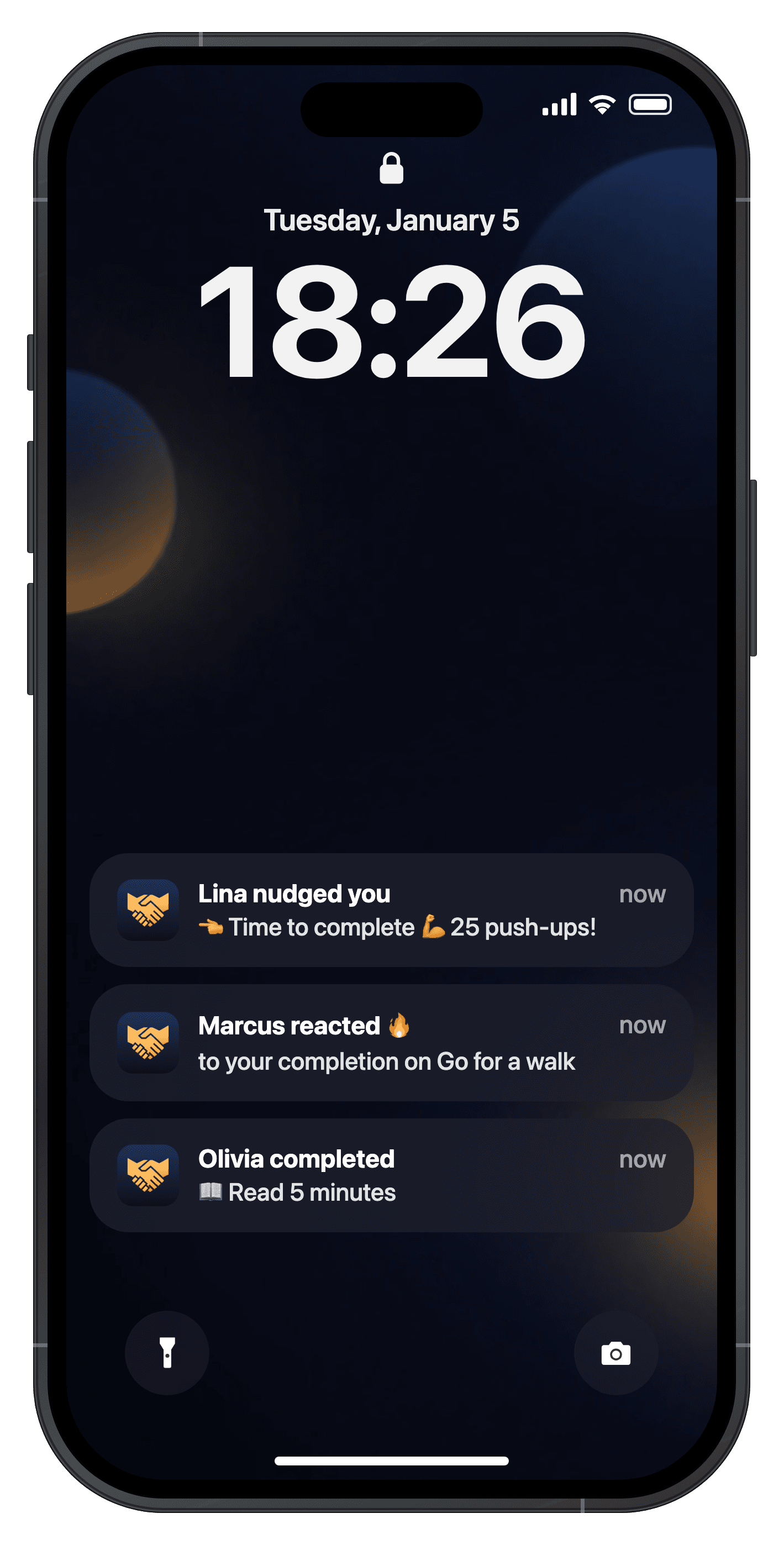
Paper cannot solve the real problem. Nobody else can see it. If your habits fail because you lose interest privately and no one notices, a better grid will not fix that. That is what an accountability partner or a small group is for. The pact tracker and the accountability chart above are the paper versions of that idea, and Daily Pact is the version that works when you are not in the same room. You check in with one tap, your friend gets a notification, and if one of you hasn't ticked today's box by evening, the other can send a nudge. Plenty of people keep both: the paper on the fridge to look at, the app so someone else is looking too.
Common questions
How do I use a printable habit tracker?
Write one habit per row, then fill in a box each day you do it. Keep it somewhere you already look, like the fridge, a desk or the inside of a notebook. The tracker only works if seeing it is unavoidable, which is the one advantage paper has over an app you have to open.
Is this habit tracker printable really free?
Yes. Every sheet on this page is free to print as many times as you like, with no signup, no email and no watermark. Pick a sheet, press Print, and choose landscape if your browser asks. It fits both US Letter and A4.
How many habits should I track at once?
One to three. Every extra row lowers the odds of finishing any of them, because a grid with gaps everywhere stops feeling like progress and starts feeling like evidence you're failing. Start with one, add a second only once the first is automatic.
What is a pact tracker?
A pact tracker is a habit tracker for two people doing the same habit. Each of you gets a row of 31 boxes, you agree on what happens after a missed day, and you both sign it. It turns a private resolution into a promise someone else can see.
What is an accountability chart?
An accountability chart is a shared version of a habit tracker: one row per person rather than one row per habit, so a group running the same challenge can see who has checked in. It works because the gaps are visible to other people rather than only to you.
Is paper or an app better for habit tracking?
Paper is better at being visible and worse at everything else. It can't remind you, it can't be seen by anyone who isn't in the room, and it's easy to abandon quietly. If you're tracking alone and want something tactile, paper is fine. If the problem is that nobody notices when you stop, you need something shared.

Or let the app keep the streak for you
Start your 14-day free trial. No credit card required.
5.0 from 13 App Store ratingsAvailable on iPhone & Android · 14 days free for new accounts