
The short answer

Daily Pact
Our pick★ 5.0 on the App StoreFor most people reading this (you have friends, you want a habit to stick, and you don't want a second job managing an app), Daily Pact is the pick. Private groups of any size, daily or weekly challenges, one-tap check-ins, a live leaderboard, and PactPause so a bad week doesn't end the group. 14 days free with everything unlocked, then $0.99 a month. Running it for a team, class or club? One person can cover everyone with a Group plan.

If that doesn't fit you
- You only want to share streaks, no challenges: HabitShare is free and does exactly that.
- You want money on the line: Squad uses credits in public squads; FineStreak fines you if you opt in.
- A whole team, class or club: Daily Pact with a Group plan, so one person pays for everyone.
- Just one partner, not a group: BuddyUp (free, Apple only) or a two-person Daily Pact group.
- No reliable friends: Cohorty matches you with strangers on the same challenge; Habit Huddle has public communities.
- You want a professional: GoalsWon (coach replies daily) or Boss as a Service (proof twice a day).
Quick comparison
| App | Groups | Challenges | Leaderboard | Streak protect | Price | Platforms |
|---|---|---|---|---|---|---|
 Daily PactOur pickPrivate groups, one plan can cover everyone | $0.99/mo after trial, or one Group plan from $9.99/mo | iOS · Android | ||||
| Habit HuddlePublic or private groups | Free / from $8/mo | Web · iOS · Android · Discord | ||||
| SquadFriend squads or public squads with stakes | Free with friends | iOS · Android | ||||
| CohortyMatched cohorts of strangers | Free | Web · iOS | ||||
| HabitShareSolo habits, shared with chosen friends | Free | iOS · Android | ||||
| BuddyUp1-on-1 accountability buddy | Free | iOS · Mac | ||||
| HabiticaGamified solo habits with parties | Free / $4.99/mo | Web · iOS · Android | ||||
| FocusmateBody doubling, 1-on-1 with strangers | Free / $8–12/mo | Web | ||||
| GoalsWonPaid human coach, 1-on-1 | $60–90/mo | Web · iOS · Android | ||||
| Boss as a ServicePaid human boss over messaging | $25–200/mo | Messaging, no app | ||||
| FineStreakAI accountability agent with optional fines | $8–20/mo | Web |
Competitor prices are US storefront, checked 10 September 2026. Daily Pact prices as of 7 November 2026. “Streak protect” means a built-in way to survive a missed day without losing your streak.
How we tested and what we looked for
We build Daily Pact, so read our pick with that in mind. To keep the rest fair, every app here was judged on the same four questions, and we say plainly where a competitor does something we don't. The full policy is on our About page.
- Who notices when you skip? A private streak counter notices nothing. A friend, a cohort, a coach or a fine does. This is the difference between a habit tracker and an accountability app.
- How fast is the check-in? If logging a day takes longer than the habit, people stop logging. One tap beats a form.
- What happens after a missed day? Apps that reset you to zero lose people in week three. Streak freezes, vacation modes and group-voted pauses keep them.
- What does it really cost? Free tiers, trials, credits and coaching fees are listed as of the date in the byline.
Do accountability apps actually work? What our data shows
They work when someone else sees your check-ins, and they work best with two or three people. In the The Daily Pact Habits Report 2026 (4,404 habits from 1,605 people), habits shared with one or two friends got 6.6 check-in days in their first month, against 1.5 for habits done alone: about 4.4x more.
The biggest gap is on day one. 54% of solo habits never got a single check-in, against 10% of shared ones. Telling someone is what gets you to start.
Size matters more than most apps admit. Habits shared by three people were still getting check-ins in week 4 26.4% of the time. With six or more people it was 3.1%, the same as doing it alone (3.1%). In a big group nobody notices one quiet member. So whichever app you pick, keep the circle that sees your check-in small, and split a big team into small groups of two or three.
Alone
3.1%
2 people
12.7%
3 people
26.4%
4-5 people
10.9%
6 or more
3.1%
Source: The Daily Pact Habits Report 2026.
See the numbers+
| People | Habits (n) | Alive in week 4 | Check-in days, month 1 |
|---|---|---|---|
| Alone | 1,615 | 3.1% | 1.5 |
| 2 people | 766 | 12.7% | 5.4 |
| 3 people | 444 | 26.4% | 8.9 |
| 4-5 people | 236 | 10.9% | 4.7 |
| 6 or more | 1,343 | 3.1% | 4.8 |
This is data from our own app, and it shows associations, not proof that the app caused the difference. People who invite friends may simply be more committed. The method and all the numbers are in the full report; what it means for finding a partner is on our accountability partner page.
Start with the setup that did best: you and two friends
Make a Daily Pact group, send the link to two people, pick one daily habit. Everyone gets the 14-day free trial.
Get Daily Pact and invite two friends
1. Daily Pact
Our pickBuilt for friend groups who challenge each other
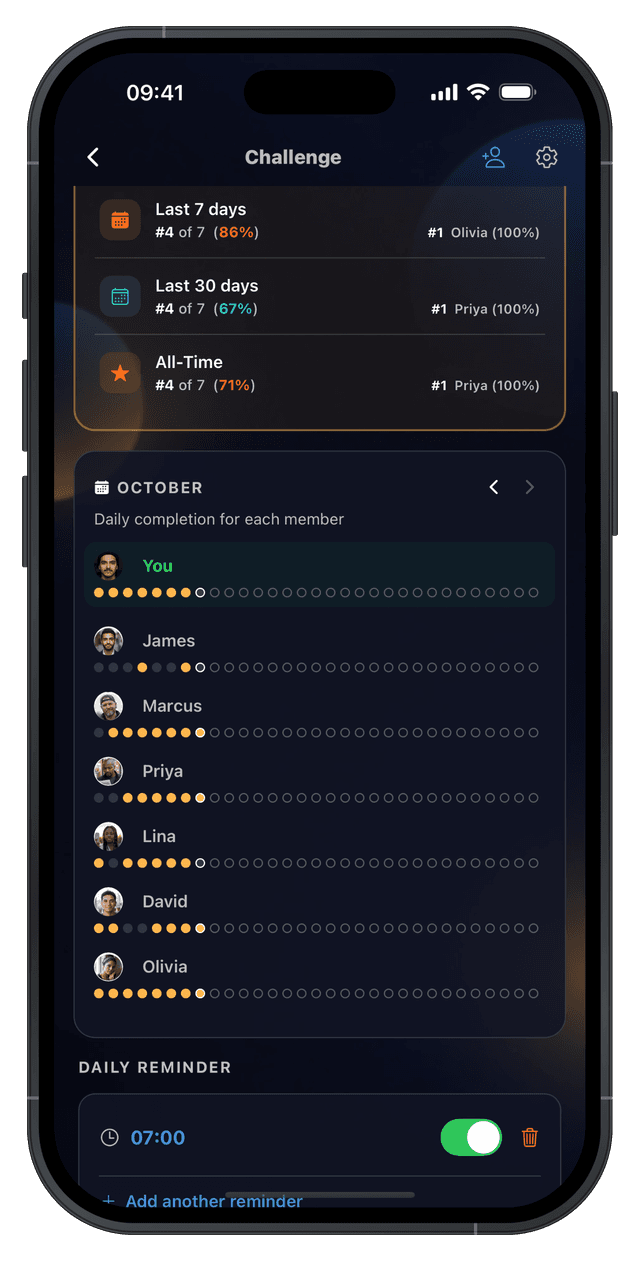
Daily Pact is designed from the ground up for group accountability. Create a private group, invite people with one link, from your contacts, by pasting an email list or with a QR code, set daily or weekly challenges, and track who actually shows up. The leaderboard ranks everyone by completion percentage, and PactPause lets the group vote to protect your streak when life gets in the way. There is no feed to scroll and no avatar to dress: you open it, tap that you did the thing, and see who else did. For a bigger group, one person can cover everyone with the Group plan, or everyone uses their own free trial.


New accounts get 14 days free · No credit card
Pros
- Rated 5.0 on the App Store
- Built for groups, from 2 friends to 1,000 people (not solo users)
- Group plan: one person covers up to 200 people, from $9.99/mo
- Invite everyone at once: link, contacts, email list or QR code
- One-tap check-in, the fastest daily tracking here
- Real-time leaderboards per challenge
- PactPause: group-voted streak protection
- Push notifications when friends check in
- Under 1 minute to set up
Cons
- No web version (mobile only)
- No free tier after the 14-day trial
- No free trial on the Group plan
2. Habit Huddle
Community habit groups with seasons and a shared streak
Habit Huddle organises people into “huddles”, which can be public communities or invite-only groups. Each member keeps an individual streak while contributing to a shared “Checkin Chain”, and monthly seasons reset the leaderboard so newcomers can still win. It has the most generous forgiveness features in this list: a streak freeze earned every 30 days, a 14-day vacation mode, and night-owl check-ins that count until 8am. The trade-off is that it is a large, feature-dense app that launched in late 2025, so the community is still forming.
Pros
- Free tier to start; unlimited habits
- Shared group streak plus individual streaks
- Monthly seasons and leaderboards
- Streak freezes and vacation mode
- Works on the web and through Discord
Cons
- Paid plans are expensive: Builder from $8/mo, Champion from $16/mo
- Very new: only a handful of App Store ratings so far
- Lots of features to learn before the first check-in
3. Squad
Challenges with credits on the line
Squad runs time-boxed challenges of one to four weeks. Private squads with friends are free. Public squads are where it gets interesting: you join with credits, earn them back by checking in, and lose one every time you miss. That “skin in the game” is the whole pitch, and it works for people who need a cost attached to skipping. Checking in that you did not do it is encouraged, which keeps the data honest.
Pros
- Private squads with friends are free
- Credits give public challenges real consequences
- Structured 10, 21 and 30-day challenges starting weekly
- Honest check-ins: logging a miss is part of the design
Cons
- Credits cost money: 12 for $9.99, 30 for $24.99, 60 for $49.99
- Squad Pro is $8.99/mo or $74.99/yr
- Challenges end after four weeks; long-term habits need re-joining
4. Cohorty
Quiet accountability with strangers who share your goal
Cohorty matches you into a cohort of 5 to 15 people who are all doing the same 7 to 30-day challenge. There is no group chat and no obligation to cheer anyone on. You check in, your cohort sees a mark, and that is the entire social contract. It suits people whose friends will not commit, or who find group chats exhausting. At the time of checking, Cohorty describes itself as free, with premium features planned.
Pros
- No friends required, cohorts are matched for you
- Free at the time of checking
- Low-noise: check-ins are visible, comments are optional
- Pre-built 7 to 30-day challenges
Cons
- You are accountable to strangers, which some people ignore
- Android not available yet
- Cohort ends with the challenge
6. BuddyUp
One buddy, one goal, optional stakes
BuddyUp pairs you with one accountability buddy rather than a group. You can track habits with streak counters or numeric goals such as miles run, hours studied or books finished, and you can turn a goal into a head-to-head challenge with stakes you agree between yourselves. It is free with no in-app purchases, which is rare. It also launched in late 2025, is Apple-only, and has a tiny user base, so treat it as a promising buddy app rather than a proven one.
Pros
- Free, with no in-app purchases
- Numeric goals as well as yes/no habits
- Head-to-head challenges with agreed stakes
- Simple: one buddy, no community layer
Cons
- No Android
- Pairs only, no groups
- Launched in late 2025, very few reviews yet
7. Habitica
Your habits are quests in an 8-bit RPG
Habitica gamifies your entire life. Every habit, daily task and to-do earns XP and gold for your pixel avatar. Parties let you team up with friends and battle bosses by completing tasks; miss a daily and the party takes damage, which is genuine peer pressure. Challenges are shared task lists you can add to your own. The RPG layer adds real complexity, though: onboarding takes 5 to 10 minutes, and the gaming metaphor is not for everyone.
Pros
- Unique RPG gamification
- Party system where your misses hurt the group
- Huge community, guilds and wiki
- Free core app on web and mobile
Cons
- Complex setup (5–10 minutes)
- Gaming metaphor doesn't suit everyone
- Optional subscription for gems and cosmetics
- Social features feel secondary to the RPG
8. Focusmate
Virtual co-working with strangers
Focusmate pairs you with a stranger for a 25, 50 or 75-minute video session. You declare your task, work in silence with your camera on, then report back. It is body doubling for remote workers rather than a habit tracker. Great for getting a specific piece of work done today; it does not track habits, streaks or group challenges.
Pros
- Effective for deep work sessions
- Real human presence boosts focus
- Three free sessions a week, no card required
Cons
- Not a habit tracker at all
- Paired with strangers, not friends
- No challenges, streaks or leaderboards
- Unlimited sessions cost $8/mo billed yearly or $12/mo monthly
9. GoalsWon
Pay for a professional accountability coach
GoalsWon assigns you a professional accountability coach who reads your daily check-in and personally replies, every day of the week, with a monthly video call on top. It is 1-on-1 rather than group-based, and it is the most hands-on option here short of hiring a coach yourself. The monthly plan has a 7-day trial; the yearly plan, which works out at $60 a month, has a 14-day trial. Weekly video calls can be added for another $150 a month.
Pros
- Professional accountability coaches
- Daily check-ins with a personal reply, not weekly
- You pick the coaching style at the start, supportive or firm
- iOS, Android and web
Cons
- $90/mo, or $720/yr, expensive next to a habit tracker
- 1-on-1 only, no group support
- No leaderboards, challenges or streaks
- Does nothing unless you check in daily
Accountability from a boss, not a peer
Boss as a Service matches you with a real human “Boss” who checks in morning and evening, Monday to Saturday, and asks for proof: a screenshot, a photo, a link. The dynamic is top-down rather than peer-to-peer. Your Boss expects progress, holds up your wins and gets you moving again after a slip. The Starter tier is messaging only; Super adds an hour of call time a month and Virtuoso two hours plus a quarterly review. It runs entirely over messaging, so there is no app to open.
Pros
- A real human Boss, not an automated nudge
- Twice-daily check-ins, Mon–Sat, on every tier
- Proof required: screenshot, photo or link
- Works over text, WhatsApp, Telegram or email
- 30-day money-back guarantee
Cons
- $25/mo Starter, $100/mo Super, $200/mo Virtuoso (yearly plans cut roughly a third)
- No app, messaging only
- 1-on-1 only, no groups or leaderboards
- Top-down pressure doesn't suit everyone
- Calls only from the $100/mo tier up
11. FineStreak
An AI agent that calls you, checks the photo, and fines you
FineStreak replaces the friend with an AI agent that calls or texts you at your chosen time and asks whether you did it. Verification scales with how strict you want to be: self-report, a photo or screenshot the AI checks, or a live photo with location and biometrics. Fines are off by default, and when you turn them on they range from ten cents to $50 per miss depending on your rank. Friend invitations exist from the Entry tier, but this is fundamentally solo accountability with a consequence attached.
Pros
- Works when no friend is reliable enough
- Verification you cannot fake at the strict tiers
- Fines are optional and off by default
- Founding price of $5/mo for the first 100 members
Cons
- Entry $8/mo, Standard $20/mo (drops to $15 after your first 7-day streak)
- Browser only for now
- No free tier
- Not social in any real sense
Best accountability partner app (1-on-1)
The best accountability partner app depends on who the partner is. With a friend, use a two-person group in Daily Pact or the free BuddyUp. With no friend to ask, Cohorty matches you with strangers. If you want someone paid to never go quiet, GoalsWon or Boss as a Service.
| Your partner is | Best app | Cost |
|---|---|---|
| A friend, partner or sibling | Daily Pact (a group of two) or BuddyUp (Apple only) | 14-day free trial, then $0.99/mo; BuddyUp free |
| Nobody yet | Cohorty (matched cohort) or Habit Huddle (public huddles) | Free; Habit Huddle paid plans from $8/mo |
| A stranger for a work session | Focusmate | Free sessions, then $8 to $12/mo |
| A paid human | GoalsWon (coach) or Boss as a Service (strict boss) | $60 to $90/mo; $25 to $200/mo |
| Software with a fine | FineStreak | $8 to $20/mo |
Competitor prices as in the reviews above, checked 10 September 2026.
An accountability partner app is for two people, and the question is who the other person is. If it is a friend, the free options are good: BuddyUp pairs you on one goal with optional stakes, and a two-person group in Daily Pact gives you a leaderboard of two, which is surprisingly motivating. The weakness of any friend-based partner app is the friend. When they go quiet, so does your accountability.
If you would rather pay for someone who will not go quiet, GoalsWon and Boss as a Service are the two real options. GoalsWon feels like coaching: a personal reply to your check-in every day and a monthly call. Boss as a Service feels like a manager: proof twice a day and no interest in your excuses. Both cost more per month than a year of most habit apps, which is the point. You are buying a human's attention.
No partner in mind yet? Our guide to finding an accountability partner online covers where to look and what to agree on before day one.
Best group accountability app
A group accountability app has to solve one problem a partner app does not: what happens when one of five people stops showing up. The good ones make the group bigger than any member. Daily Pact does it with a per-challenge leaderboard and PactPause, so a member can pause without breaking the group and the other four keep going. Habit Huddle does it with a shared Checkin Chain and monthly seasons. Squad does it with credits, so skipping costs something.
If you do not have a group, Cohorty builds one for you from strangers on the same 7 to 30-day challenge, and Habit Huddle's public huddles work the same way at a larger scale. Matched groups are less personal, and for some people that is exactly why they work. For a deeper look at running challenges as a group, see our guide to the best group accountability apps for challenges with friends.
Best accountability app for groups: one plan for everyone
Once a group gets past a handful of friends, two practical problems show up: getting everyone in, and getting everyone to pay. Almost every app here bills each person separately, so a coach, team lead or teacher has to ask 30 people to sign up and subscribe. Daily Pact is the only one on this list built so one person can run the whole thing.
- One person can cover everyone. The organizer buys a Group plan and everyone in their groups is covered, so nobody hits a paywall. Members see who covers the group. The organizer gets full Pro too.
- Or everyone pays for themselves. Each person gets their own 14-day free trial, then $0.99/mo. You pick when you create the group.
- Invite everyone at once, four ways. Share one link in WhatsApp, Slack or iMessage. Pick several people from your contacts. Paste an email list straight from a spreadsheet (up to 200 at a time) and see who opened and who joined. Or show a QR code at a class, meeting or the gym.
- Big groups are fine. A group holds up to 1,000 people, and the leaderboard does the noticing that a group chat can't.
| Group size | Group plan (one person pays) | Everyone on Pro monthly |
|---|---|---|
| Up to 15 | $9.99/mo or $99.99/yr | $14.85/mo |
| Up to 50 | $24.99/mo or $249.99/yr | $49.50/mo |
| Up to 200 | $49.99/mo or $499.99/yr | $198/mo |
The organizer is covered on top of the member count. Yearly plans get two months free. There's no free trial on the Group plan, you can cancel anytime, and you can move up a tier whenever the group grows. Per-seat wellness tools typically charge $3 to $8 per employee per month.
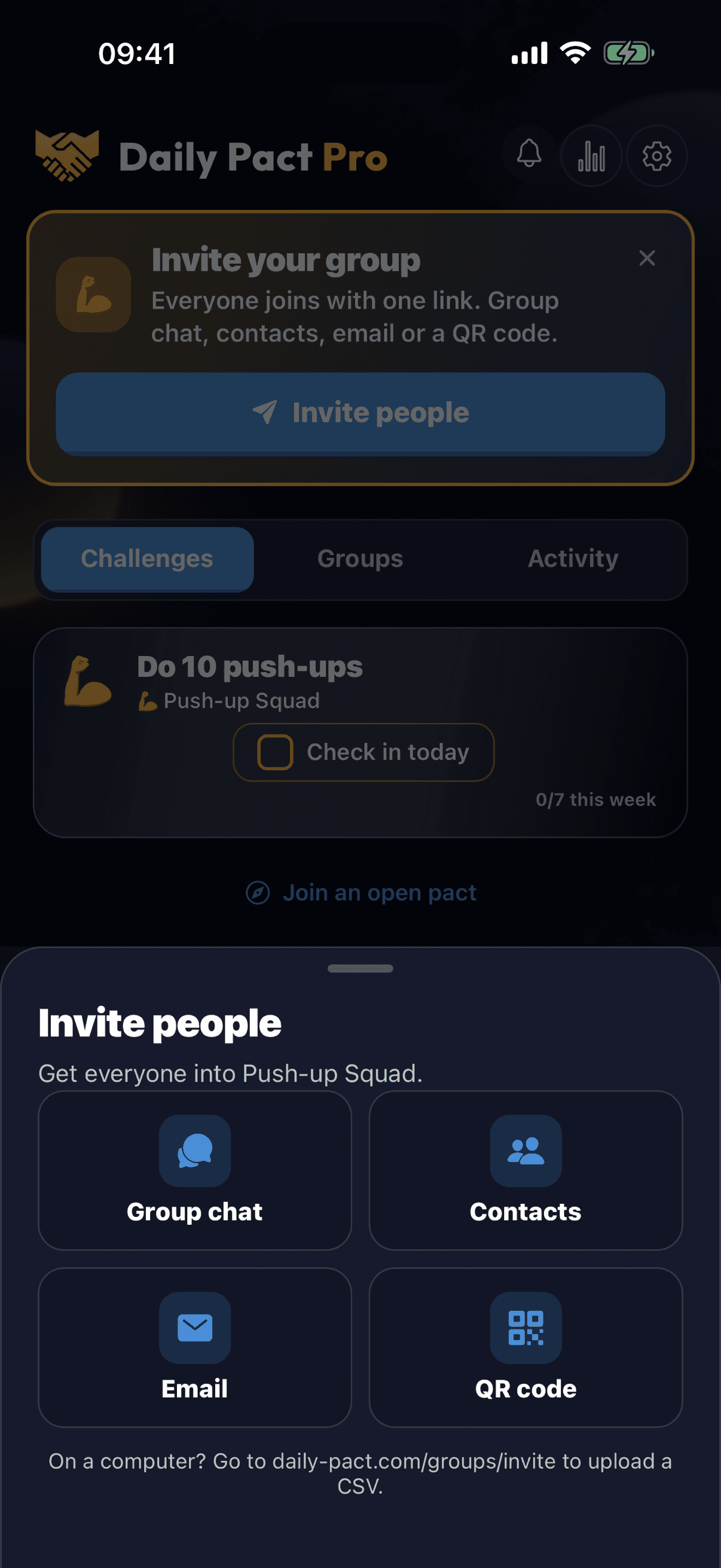
The Group plan is bought on the web or in the app: open your group and tap “Cover your whole group”, or choose “A group” when you sign up. People beyond your plan's limit can still join on their own trial.
Best accountability apps for iPhone
Every app on this page runs on iPhone. Three are Apple-only, which matters if your friends are on Android: BuddyUp (iPhone, iPad and Mac), and in our other guides Sweatmates and GymRats. For an all-iPhone friend group those are fine; for a mixed group pick from the cross-platform list below. Daily Pact, Habit Huddle, Squad, HabitShare and Habitica all have iPhone apps; Focusmate and FineStreak run in Safari.
Best accountability apps for Android
With Android in the group your options are Daily Pact, Habit Huddle, Squad, HabitShare and Habitica, plus the browser-based Focusmate and FineStreak, and the coaching services (GoalsWon has an Android app; Boss as a Service is messaging). Cohorty lists Android as coming; BuddyUp is Apple-only.
Internet accountability apps are a different kind
Internet accountability apps watch what you do on your devices and report it to a person you trust. Covenant Eyes, Ever Accountable, Accountable2You and Canopy are the best known, and most people use them to quit pornography or cut screen time. None of the apps on this page monitor your phone. They only know what you check in.
The two kinds work well together: a monitoring app for what you want to stop, and a check-in app for what you want to start, like reading, prayer or exercise. Our guide to the Christian accountability app compares both kinds side by side.
How to make friend accountability last past week three
Whichever app you choose, most groups die the same way: enthusiasm for ten days, one person misses, nobody says anything, and the silence spreads. Four habits prevent it.
- Pick one habit per challenge, phrased so the check-in is a yes or no. “Walk 8,000 steps” beats “be more active”.
- Set an end date. Thirty days with a finish line gets completed; “forever” gets abandoned. Start the next one the day after.
- Decide in advance what a missed day means. A pause, a freeze, a lost credit or nothing at all. The rule matters less than agreeing on it before anyone needs it.
- Keep the group small enough to notice a gap. Between three and eight people, everyone's absence is visible. Above that, use a leaderboard to do the noticing for you.
Our step-by-step guide to starting a 30-day challenge with friends covers the setup conversation in detail.
Planning a New Year's resolution? Pick one small habit and one friend before January 1, then check in every day of January together. Our guide to goals for the new year helps you choose the habit, and how to find an accountabilibuddy covers the friend.
Frequently Asked Questions
Is there an app that keeps you accountable?
Yes. An accountability app keeps you accountable by making someone else see whether you did the thing: a friend group (Daily Pact, HabitShare, Squad), matched strangers (Cohorty, Habit Huddle), a paid human (GoalsWon, Boss as a Service) or a fine (FineStreak). A plain habit tracker only shows you a private streak, which is easy to ignore. For habits with friends, Daily Pact is our pick: a shared daily check-in, a leaderboard and a 14-day free trial.
Do accountability apps actually work?
They work when the check-ins are shared. In the Daily Pact Habits Report (4,404 habits from 1,605 people), habits shared with 1-2 friends got 6.6 check-in days in their first month, against 1.5 for habits done alone, and 54% of solo habits never got a single check-in, against 10% of shared ones. Groups of three did best. These are associations from one app's data, not proof that the app alone caused it.
What is the best accountability app for friends?
Daily Pact is the best accountability app for building habits with friends. Unlike solo apps, it lets you create private groups, set shared daily or weekly challenges, and track progress together with leaderboards. It's free to start with a 14-day trial, then $0.99 a month.
What is the best group accountability app?
For a group you already know, Daily Pact: structured challenges, a leaderboard and group-voted streak protection. For a group you don't have yet, Cohorty matches you into a cohort of 5 to 15 strangers on the same challenge, and Habit Huddle offers public huddles with monthly seasons. Squad sits in between: private squads with friends are free, and public squads add credits as stakes. For a bigger group like a team, class or club, Daily Pact lets one organizer cover everyone with a single Group plan.
What is the best accountability partner app?
It depends on who you want as your partner. If you want a friend, BuddyUp pairs two people on one goal for free on iOS, and Daily Pact does the same as a two-person group with a leaderboard. If you want a paid professional, GoalsWon assigns a coach who reads your check-in daily ($90/mo, or $720/yr), and Boss as a Service gives you a strict human Boss who asks for proof twice a day ($25 to $200/mo). Peer accountability is far cheaper; paid coaching is more structured.
Is there a free accountability partner app?
Yes. For a single accountability partner, BuddyUp is completely free, and HabitShare lets you share habits with friends for free. Cohorty and Habitica are free with premium features optional or planned. Squad is free for private squads with friends, Habit Huddle has a free tier, and Focusmate includes three free co-working sessions a week. Daily Pact gives you a 14-day free trial with every feature unlocked, then costs $0.99/mo. The paid coaching services start at $25/mo, so the gap between free and professional is wide.
What is the best accountability app for a large group, like a team, class or club?
Daily Pact. Groups hold up to 1,000 people, and one organizer can cover everyone with a Group plan: $9.99/mo for up to 15 people, $24.99/mo for up to 50 and $49.99/mo for up to 200 (yearly plans get two months free). Members never see a paywall. Invite everyone at once with one link in the group chat, several contacts at a time, a pasted email list or a QR code. If you'd rather not pay for everyone, each person can use their own 14-day free trial and then $0.99/mo.
Can one person pay for the whole group?
In Daily Pact, yes. The organizer buys a Group plan on the web at daily-pact.com/groups or in the app (open the group and tap "Cover your whole group") and it covers the first 15, 50 or 200 people across all of their groups, plus the organizer. A 50-person team costs $24.99/mo, against $49.50/mo if all 50 paid $0.99 each. Most other accountability apps bill each person separately.
What is an accountability buddy app, and do they work?
An accountability buddy app connects you with someone who checks whether you did what you said you would. They work when three things are true: the check-in is fast enough that you actually do it, someone notices when you skip, and there is a way to recover from a missed day without giving up entirely. Apps that only show a private streak counter fail the second test, which is why most people stop opening them within a few weeks.
What if my friends keep dropping out?
Pick an app that does not depend on them. Cohorty matches you with strangers doing the same challenge, Focusmate pairs you with a stranger for a work session, and FineStreak, GoalsWon and Boss as a Service replace the friend with an AI agent or a paid human. In Daily Pact, PactPause and the leaderboard keep a group alive when one member goes quiet, but the group still has to exist.
What's the difference between an accountability partner and an accountability group?
An accountability partner is a single person who holds you accountable, usually 1-on-1. An accountability group is three or more people working toward shared goals. Groups tend to hold up better because one person going quiet doesn't end the arrangement. Daily Pact groups can hold up to 1,000 people.
Related comparisons
Best group accountability apps for challenges
Apps built for challenges you run as a group, not solo.
Accountability apps for couples
The two-person version of this question.
Workout accountability apps
Gym, running and fitness with friends.
Shared habit tracker apps
One tracker several people can see.
Habitica alternatives
If the RPG layer is too much, here is what else works.
Team accountability apps
Challenges for a team of 10, 50 or 200.
Free habit trackers with friends
What you actually get without paying, compared.
Try Daily Pact free for 14 days
Start your 14-day free trial. No credit card required.
5.0 from 13 App Store ratingsAvailable on iPhone & Android · 14 days free for new accounts