
What is an accountability group?
An accountability group is three or more people who commit to a goal and report progress to each other on a fixed schedule. It is the same mechanism as an accountability partner, with one structural difference that matters more than it sounds: no single person can end it by losing interest.
That difference is most of the value. A two-person arrangement has one point of failure: when your partner drifts, your accountability goes with them, usually without a conversation. In a group of five, one person going quiet is visible and survivable. The remaining four keep reporting, and the person who lapsed has something to come back to rather than a dead thread.
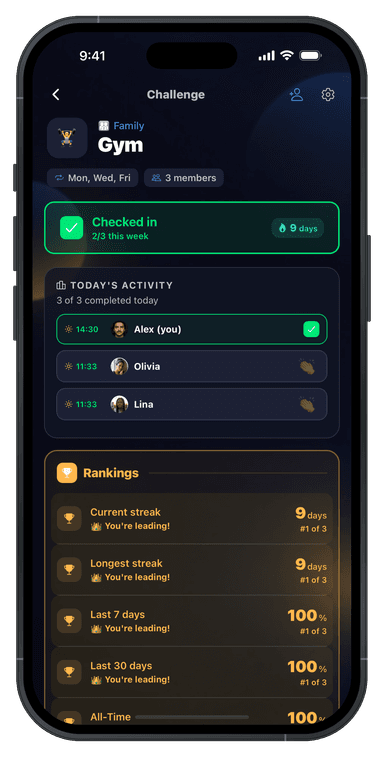
Group accountability also removes the job nobody wants. In a pair, someone has to ask “did you do it?”, which reads as nagging between friends, so in practice nobody asks and the arrangement quietly dissolves. When everyone's progress is visible by default, being behind is simply information. No one has to raise it. In Daily Pact that is the first thing you see on a challenge: how many of you have checked in today. If it's 9pm and one name is missing, a nudge from the app says it for you, without anyone writing the awkward message.
How big should an accountability group be?
Three to six is the working range. Below three you have a pair with extra steps. Above roughly eight, individual check-ins stop being noticeable and the social pressure that makes it work starts to thin out: you become an audience rather than participants.
Larger groups can work when the challenge is competitive rather than supportive, because a leaderboard keeps individual performance legible in a way conversation cannot. That is the one case where 20, 50 or 200 people still functions, and where it helps that one person can invite and cover the whole group. Getting 30 people in is usually the hard part, so Daily Pact invites four ways: one link in the group chat, several contacts at once, a pasted list of up to 200 emails (you can see who opened the invite and who joined), or a QR code on a screen.
What Makes a Good Group Challenge or Habit Competition App?
- Easy group creation: invite everyone at once by link, contacts, email list or QR code
- Flexible challenges: daily, weekly, any goal
- Progress tracking: see who's keeping up
- Leaderboards: friendly competition drives consistency
- Notifications: know when friends check in
- Streak protection: life happens, don't lose progress unfairly
- Simple billing: one person can pay for the whole group
Which Apps Have the Best Group Challenge Features?
For a private group of friends, Daily Pact has the most complete set: any goal, daily or weekly, a live leaderboard, streaks, nudges for whoever hasn't checked in, a voted PactPause and one plan that covers everyone. Strava clubs suit runners and cyclists, GymRats suits workout groups, and Habitica suits groups who want a game.
| App | Best group feature | Good for |
|---|---|---|
| Daily Pact | One-tap check-ins, live leaderboard, PactPause, one plan for the group | Any habit or fitness challenge, iPhone and Android |
| Strava | Clubs, club challenges, kudos on each activity | Running, cycling, walking |
| GymRats | Workout challenges scored on logged sessions | Gym and workout groups |
| Apple Fitness | Seven-day competitions between two friends | Apple Watch owners, one rival at a time |
| Habitica | Parties and quests | Groups who like RPG games |
Best app for group fitness challenges with friends
Pick the app everyone in the group can use on their own phone, that counts what you agreed to count. If the challenge is “work out every day” or “30 minutes of movement”, Daily Pact works for a mixed iPhone and Android group: everyone taps once when they're done, whatever they trained with, and the leaderboard ranks the group by consistency. If everyone runs and wants distance totals, a Strava club does that better.
Need an idea to start with? Our fitness challenges with friends has 25+ group challenges, and workout accountability apps compared goes deeper on gym and running apps. If motivation is the problem, see fitness apps for motivation.

Daily Pact: Built for Group Challenges
Our pick14 days free, then $0.99/mo each, or one Group plan from $9.99/mo
Daily Pact checks every box above, and it's built around the moment most group challenges die: the week one friend goes quiet. Everyone checks in with one tap, the group gets a notification when someone does, and anyone can nudge the person who hasn't. The leaderboard keeps a big group legible, ranked by streak and completion. And when someone is ill or travelling, they ask for a PactPause: the group votes, their streak is protected, and a PAUSED badge shows next to their name, so a sick week reads as a pause rather than a dropout.
Running it for a whole group?
A running club, a class, a team or a big friend group? Daily Pact groups hold up to 1,000 people, and the organizer can sort out invites and billing in one go.
- Invite everyone at once: one link in the group chat, several contacts at a time, a pasted email list (up to 200 at a time), or a QR code at the meeting.
- One person can cover everyone: the Group plan is $9.99/mo for up to 15 people, $24.99/mo for 50 or $49.99/mo for 200. Members never see a paywall.
- Or everyone pays for themselves: each person gets their own 14-day free trial, then $0.99/mo.
Alternatives to Consider
Habitica
RPG gamification meets group quests
Habitica lets you form parties and run challenges, but the RPG layer (avatars, gear, boss fights) adds friction for people who just want a simple group challenge. Party challenges are community-run, not structured. Good for gamers, confusing for everyone else.
Pros
- + Free core features
- + Parties and guilds
- + Creative gamification
Cons
- − Complex RPG interface
- − No real leaderboards
- − Learning curve
WhatsApp / Slack
The DIY accountability group
Many friend groups start here: a group chat where everyone posts updates. It works for motivation but has zero structure. No automatic check-ins, no streak tracking, no leaderboards. Messages get buried, people forget to post, and there's no way to see who's actually consistent over time.
Pros
- + Free
- + Everyone already has it
- + Low friction to start
Cons
- − No tracking
- − No streaks or leaderboards
- − Messages get buried
Spreadsheets / Notion
The manual tracking approach
Some groups build shared Google Sheets or Notion boards. This requires someone to set it up and maintain it, and it only works if everyone remembers to update it daily. No push notifications, no mobile-first experience, and the tracking burden falls on one person.
Pros
- + Fully customizable
- + Free
- + Works for small groups
Cons
- − Manual effort
- − No notifications
- − Not mobile-friendly
Frequently Asked Questions
What is a group accountability app?
A group accountability app lets three or more people commit to the same habit or challenge and see each other's check-ins. The good ones add structure a group chat can't: a per-challenge leaderboard, streak tracking, notifications when someone checks in, and a way to pause without breaking the group. Daily Pact, Habit Huddle and Squad are built this way; Cohorty does the same with a cohort of strangers it matches for you.
What is the best group accountability app?
For a group of friends, Daily Pact: private groups of any size, daily or weekly challenges, a live leaderboard and PactPause, and one Group plan if a single person wants to cover everyone. If you want a public community with monthly seasons, Habit Huddle. If you want stakes, Squad's public squads run on credits. If you don't have a group yet, Cohorty matches you into one. Our full roundup compares all of them on price and features.
Is there a habit competition app for friends?
Yes. Daily Pact ranks everyone in a private group by completion percentage on a live leaderboard, so any habit becomes a friendly competition. GymRats does it for workouts on iPhone, Squad adds credits as stakes in public squads, and Habit Huddle runs monthly seasons. For a team at work, see our team habit tracker guide.
What is the best app for group challenges?
Daily Pact is purpose-built for group challenges. Create a private group, invite everyone at once (one link, contacts, an email list or a QR code), and set daily or weekly challenges for any goal. Features include real-time leaderboards, streak tracking, PactPause, and push notifications. Each person gets a 14-day free trial, or one organizer covers the group with a Group plan from $9.99/mo for 15 people.
What is the best app for group fitness challenges with friends?
For a mixed group of iPhone and Android friends, Daily Pact: everyone taps once a day when they've done the workout, whatever they trained with, and a live leaderboard ranks the group by consistency, with PactPause for planned rest days. For runners and cyclists who want distance totals, a Strava club. For two Apple Watch owners, Apple Fitness competitions.
Can one person pay for a group challenge app for everyone?
In Daily Pact, yes. The organizer buys a Group plan in the app and covers up to 15 people for $9.99/mo, 50 for $24.99/mo or 200 for $49.99/mo, so members never see a paywall. Groups themselves can hold up to 1,000 people. If nobody wants to pay for everyone, each person uses their own 14-day free trial and then $0.99/mo.
Can I do a 30-day challenge with friends using an app?
Yes. Daily Pact supports time-boxed challenges with optional end dates. Set a 30-day challenge, invite your friends, and track daily check-ins together. The leaderboard shows who's keeping up and the weekly dots visualize everyone's consistency.
Start a group challenge today
Start your 14-day free trial. No credit card required.
5.0 from 13 App Store ratingsAvailable on iPhone & Android · 14 days free for new accounts