
Here is how to stay consistent: make the habit small enough to do on your worst day, tie it to a fixed time, track it where someone else can see it, and plan for missed days instead of restarting. Consistency comes from that setup, not from motivation, which is always gone by week two.

Ready to build habits with friends?
Start your 14-day free trial. No credit card required.
You don't have a motivation problem. You have a consistency problem.
Most people can start a new habit. The excitement of day 1 carries you through the first week. But by week 2, the novelty wears off, life gets busy, and the habit quietly dies. A University College London study (Lally et al., 2010) found it took a median of 66 days for a new daily behavior to become automatic, with a range of 18 to 254 days. Most of us give up long before that.
The missing ingredient isn't more motivation. It's a system, with another person in it.
How to stay consistent: 7 rules that work
Being consistent means doing a small thing on most days, not doing a big thing perfectly. The seven rules below are the ones that keep a habit alive past the first two weeks: shrink it, schedule it, make it visible, and decide in advance what a missed day means. Pick the two you are missing and start there.
- Make it small enough for your worst day. "Run 5K" fails on a tired Tuesday. "Put on running shoes and go outside" doesn't. Scale up once it's automatic, not before.
- Give it a fixed time and place. "After coffee, at the kitchen table" beats "sometime today." A habit tied to something you already do needs no decision.
- Do one thing at a time. Four new habits at once is four chances to quit. Add the second one after the first has survived three weeks.
- Track it daily, and track the rate, not just the streak. 25 of the last 30 days is a habit. A broken streak only feels like failure because you counted the wrong thing.
- Make it visible to someone else. A friend who sees whether you showed up today is the strongest single tool on this list (the research is below).
- Never miss twice. One missed day is an accident. Two in a row is the start of quitting. Decide now that after a miss, tomorrow is not optional.
- Expect the dip in week two. The novelty ends around day 8 to 14, and that is where most habits die. Plan for it: lower the bar that week, don't raise it.
What 4,404 habits say about staying consistent
In our app data, consistency comes down to four things: getting back the day after a miss, a target you can actually hit, a regular time of day, and a friend who responds. These come from the Daily Pact Habits Report 2026 (4,404 habits). They show association, not cause, but each one lines up with a rule above.
One missed day is fine, two is where habits end
After a single missed day, 28.0% of shared daily habits got a check-in the very next day, and 52.7% came back within a week. After two missed days in a row, only 15.1% came back the next day. For solo habits the numbers were 19.1%, 39.5% and 9.6%. The second miss is where the odds drop, which is why "never miss twice" is the rule worth keeping.
With others
Back next day
28%
Within a week
53%
After 2 misses
15%
Alone
Back next day
19%
Within a week
40%
After 2 misses
10%
n = 4,339 missed days in shared daily habits, 975 in solo ones. Source: The Daily Pact Habits Report 2026.
See the numbers+
| With others | Alone | |
|---|---|---|
| Back the next day after 1 missed day | 28% | 19.1% |
| Back within a week after 1 missed day | 52.7% | 39.5% |
| Back the next day after 2 missed days | 15.1% | 9.6% |
A few times a week can beat every day
Habits with a weekly target ("3 times a week") were more likely to still be going in week 4 than daily habits: 11.4% against 7.1%. Setting a reminder made almost no difference on its own (7.9% with one, 7.7% without). If every day keeps breaking, a smaller weekly target is a reasonable way to stay consistent, and a reminder is no substitute for a fixed time.
A few times a week
11.4%
Every day
7.1%
Reminder set
7.9%
No reminder
7.7%
n = 3,784 daily and 620 weekly-target habits; 520 with a reminder, 3,884 without. Source: The Daily Pact Habits Report 2026.
Most people check in in the evening
The busiest hour for check-ins was 8 to 9 pm, with 14.2% of all same-day check-ins, and close to half came between 6 pm and 11 pm. Mornings had a smaller bump between 7 and 10 am. Pick the time that matches when you actually have room in your day, and tie the habit to something that happens then, like dinner or brushing your teeth.
n = 18,442 check-ins made on the day itself, in the person's time zone. Source: The Daily Pact Habits Report 2026.
See the numbers+
| Hour | Share |
|---|---|
| 12am | 0.9% |
| 1am | 0.3% |
| 2am | 0.1% |
| 3am | 0.1% |
| 4am | 0.2% |
| 5am | 0.8% |
| 6am | 1.4% |
| 7am | 3.6% |
| 8am | 4.4% |
| 9am | 4.6% |
| 10am | 3.4% |
| 11am | 3.4% |
| 12pm | 2.6% |
| 1pm | 3.4% |
| 2pm | 3.4% |
| 3pm | 3.5% |
| 4pm | 4.3% |
| 5pm | 4.8% |
| 6pm | 6.3% |
| 7pm | 9.2% |
| 8pm | 14.2% |
| 9pm | 9.9% |
| 10pm | 8% |
| 11pm | 7.2% |
A friend's reaction keeps you going
Shared habits where a friend reacted to a check-in in the first week were still going in week 4 in 33.3% of cases, against 7.2% without a reaction. They also got 11 check-in days in their first month, against 4.9. Being seen is part of it. Being seen and answered is more.
7.2%
no reaction
33.3%
a friend reacted
4.9 days
no reaction
11 days
a friend reacted
n = 357 shared habits with a reaction in week 1, 2,432 without. Source: The Daily Pact Habits Report 2026.
Why you can't stay consistent (it's not you)
Most people stop because the habit was too big, lived only in their head, and one missed day turned into a week. Our own app data shows how early this happens: 86% of habits that stopped got their last check-in within two weeks, whether people did them alone or with others. The typical solo habit that stopped got its last check-in on day 1, and shared ones on day 6 (Daily Pact Habits Report 2026 (4,404 habits)). The first two weeks decide most habits, so that is where your system has to be strongest.
The rest of this guide is about the fix that moves that number most: other people.
Why Solo Goal-Setting Fails
When a goal exists only in your head, or in a private app, skipping has zero consequences. Nobody notices. Nobody cares. Your brain quickly rationalizes: "I'll start again tomorrow."
This is called the intention-action gap, and psychologists have studied it extensively. People consistently overestimate their ability to follow through on intentions. The gap between "I want to do this" and "I did this" is vast.
Solo strategies try to bridge this gap with tools: alarms, reminders, streak counters, habit trackers. These help, but they don't solve the core problem. When the only person you're accountable to is yourself, and you can dismiss a notification in 0.3 seconds, the system breaks down.
The Science of Social Accountability
You'll often see a table claiming that a "specific accountability appointment" gives you a 95% chance of success. That number gets passed around a lot, but nobody has ever produced the study behind it, so we don't use it. The real research is more modest and still makes the case:
- Gail Matthews, Dominican University of California: participants who wrote down their goals, committed to actions and sent weekly progress reports to a friend achieved more of their goals than those who only thought about them. Of all the steps, reporting to someone helped most.
- Wing and Jeffery, 1999: in a weight-loss program, people who signed up with friends and got social support were more likely to finish (95% versus 76%) and to keep the weight off at 10 months (66% versus 24%) than people who joined alone.
Our own numbers point the same way. In week 2, 50.3% of habits shared with one or two friends were still getting check-ins, against 11.8% for habits done alone, and habits shared with one or two friends got 6.6 check-in days in their first month against 1.5 for solo habits (Daily Pact Habits Report 2026 (4,404 habits)).
None of this is a law of nature. It all points the same way: a goal that other people can see is a goal you're more likely to keep. It's not about willpower. It's about creating a social commitment that makes quitting harder than continuing.
How Social Accountability Works
Three psychological mechanisms make social accountability powerful:
1. Social Commitment
When you tell your friends "I'm working out every day this month," you create a public commitment. Breaking it means losing face. This isn't about shame. It's about identity. You've declared yourself someone who works out daily. Skipping contradicts the identity you've publicly claimed.
2. Peer Observation
Behavioral studies show that people perform better when they know they're being observed. In group challenges, every check-in is visible to the group. Your friends can see whether you showed up today. This alone makes consistency significantly more likely.
3. Positive Reinforcement Loop
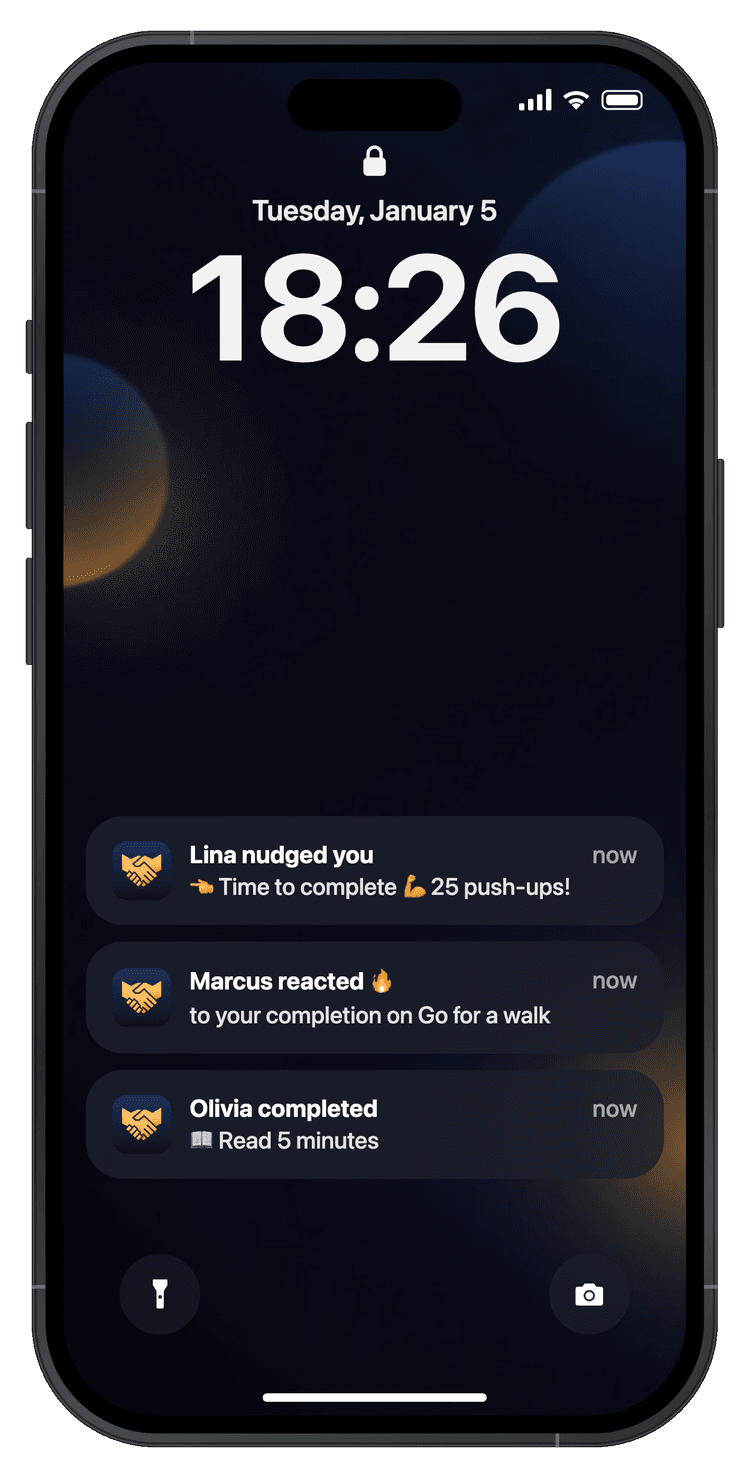
When a friend completes their challenge and you get a notification, it triggers a desire to match their behavior. When you check in and someone reacts, it reinforces the behavior. Over time, these micro-interactions build intrinsic motivation. You don't just do it for others, you start doing it for yourself.
How to Set Up a Social Accountability System
You don't need anything complicated. Here's the minimum viable system:
Step 1: Find 2 to 5 Friends With Similar Goals
Not identical goals, just similar vibes. A fitness challenge group doesn't need everyone doing the same workout. One person runs, another lifts, another does yoga. The shared commitment is daily movement, not a specific exercise.
Step 2: Pick One Challenge
Resist the urge to track 5 habits. Start with one. The constraint forces focus and makes the check-in trivial. You can always add more challenges after the first one sticks.
Step 3: Use a Dedicated Tracking System
Group chats don't work: messages get buried and there's no way to track who's actually consistent over time. I built Daily Pact because our own group chat had exactly this problem. What a dedicated system needs, and what the app does:
- A check-in that takes one tap, so reporting never becomes the hard part
- A shared view of who showed up today, so nobody has to ask
- Streaks you build together, yours and the group's, so a skipped day costs something you can see
- Push notifications when friends check in, plus your own daily reminders, so the habit finds you instead of the other way round
- Leaderboards for groups that like a little competition
Step 4: Check In Daily (Not Weekly)
Daily check-ins build daily habits. Weekly reviews are too infrequent. You can miss 4 days before anyone notices. A daily system catches missed days immediately and creates a routine of accountability.
Step 5: Celebrate Consistency, Not Perfection
Nobody hits 100% over 30 days. What matters is the trend. Celebrate 90% completion. Recognize someone who came back after missing two days. Use PactPause for genuinely impossible days: you ask the group for a break, they vote, and paused days don't break your streak or lower your completion rate. The system supports real life, not arbitrary perfection.
What If You Don't Have Friends Who Want to Join?
Start with two people. One friend is enough to create meaningful accountability. You can also post in communities like r/GetMotivatedBuddies or r/accountability to find accountability partners who share your goals. Our guide to finding an accountability partner online covers more options, and when you've found someone, inviting them to a pact by name gives them their own link and a seat held for them.
Once you have 2 or 3 people tracking together, the dynamic takes care of itself. Each person's consistency motivates the others. The leaderboard creates natural competition. The group becomes self-sustaining.
How to get back on track after missing days
Restart with the smallest version of the habit tomorrow, not a catch-up session. Don't try to make up the missed days, and don't wait for Monday or the first of the month. Tell your partner or group you're back, check in once, and count the trend from there.
- Shrink it for a week. If you missed because it was too much, the bar was too high. Halve it.
- Find what broke. Travel, a late shift, a sick kid? Write down the one change that covers it next time, like a 10-minute version for travel days.
- Plan breaks before they happen. A trip you know about is not a miss. In Daily Pact you ask the group for a PactPause, and the paused days don't count against you.
If you need a push on a hard day, a few lines from our consistency quotes can help, and our guide to how long it takes to form a habit explains why weeks three to ten still need the system.
Frequently asked questions
How do I stay consistent when I lose motivation?
Stop relying on motivation. Make the habit small, tie it to a fixed time, and let someone else see whether you did it. Motivation always fades in the first two weeks; a habit that someone expects you to check in on survives that dip.
How long does it take to become consistent?
In a University College London study, a new daily behavior took a median of 66 days to feel automatic, with a range of 18 to 254 days. Plan for about two months of deliberate effort, and expect the first two weeks to be the hardest.
Why can't I stay consistent with anything?
Usually the habit is too big, it has no fixed time, nobody else knows about it, and one missed day becomes a reason to stop. Fix those four things before you blame willpower.
What is the best way to stay consistent with goals?
Break the goal into one daily or weekly action, track it every day, and share it with a friend or small group who can see your check-ins. A partner is the single strongest tool; see what an accountability partner does.
Does missing one day ruin a habit?
No. In the Daily Pact Habits Report 2026, 28% of shared daily habits got a check-in the day after a single miss, and about half came back within a week. After two missed days in a row, only 15% came back the next day, so the rule is to never miss twice.
Is it better to do a habit every day or a few times a week?
If every day keeps breaking, try a weekly target. In our data, habits with a few-times-a-week target were still going in week 4 more often than daily ones, 11.4% against 7.1%.
The Bottom Line
Consistency isn't about discipline or motivation. It's about designing an environment where skipping is harder than showing up. Social accountability, having friends who can see your progress, is the most useful consistency tool most of us have.
Pick a goal. Find friends. Track together. That's it.
Ready to build habits with friends?
Start your 14-day free trial. No credit card required.