The short answer

Daily Pact
Our pick★ 5.0 on the App StoreFor a friend group with different phones and watches.
Set a daily target, count with whatever you each have, and tap once in Daily Pact when you've hit it. Everyone's on the same leaderboard, nobody's health data goes anywhere, and PactPause covers a sick day. iPhone and Android. Free for 14 days, then $0.99 a month.

If that doesn't fit you
- Everyone has a wearable and wants exact totals: Stridekick, organiser pays from $12.99 a month.
- Nobody has a wearable but you want real counts: Pacer counts from the phone, free.
- It's two Apple Watch owners: the built-in Fitness competition.
- It's "a walk every day" rather than a step count: a free Strava club.
Quick comparison
| App | Groups | Counts steps | iPhone + Android | Free tier | Price | Platforms |
|---|---|---|---|---|---|---|
 Daily PactOur pickManual check-in, any counter Daily PactOur pickManual check-in, any counter | $0.99/mo after trial | iOS · Android | ||||
| StridekickDevice sync, organiser pays | Free / from $12.99/mo | iOS · Android | ||||
| PacerPhone pedometer, groups | Free / $49.99/yr | iOS · Android · Watch | ||||
| Apple Fitness competitionsWatch-to-watch | Free | Apple Watch | ||||
| StravaGPS activities, clubs | Free | iOS · Android · Web |
Prices are US storefront, checked 10 September 2026. "Counts steps" means the app reads steps itself; Daily Pact records a check-in instead.
How we chose
We build Daily Pact, so read our pick with that in mind. Every app here was judged on the same questions: who notices when you skip, how fast the check-in is, what happens after a missed day, and what it really costs. We say plainly where another app does something we don't. The full policy is on our About page.

1. Daily Pact
Our pickCheck in when you hit your number — any device counts
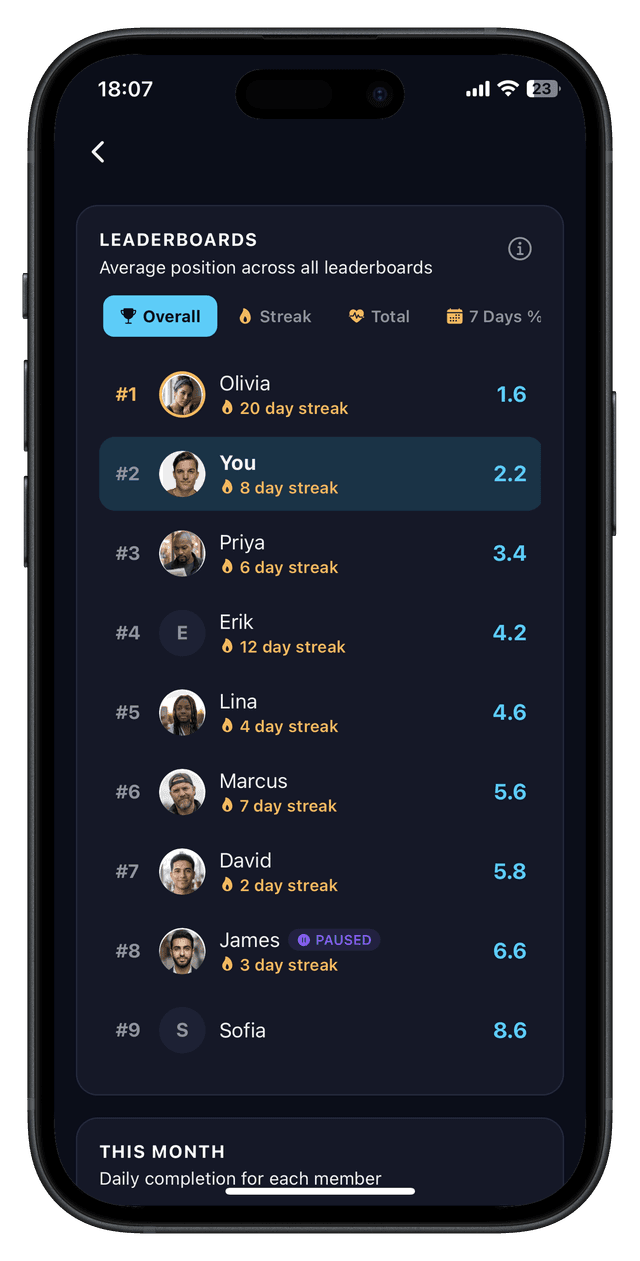
Daily Pact doesn't read your steps. Everyone agrees a daily target, counts with whatever they have — iPhone Health, Google's counter, a Fitbit, a Garmin, a pedometer — and taps once when they've hit it. That sounds like a weakness until you try to get four friends with four different devices onto one leaderboard: it's the only setup where nobody is excluded and nobody has to trust a sync. The leaderboard ranks the group by days completed, notifications show who's already walked, and PactPause covers a sick day. It's the answer to "is there a step challenge app with friends for Android and iPhone", because it doesn't care which.


New accounts get 14 days free · No credit card
Pros
- Works with every phone and watch, or none
- Nobody's data leaves their device
- Leaderboard by days hit, not by who has the best sensor
- PactPause for sick days and travel
- Groups up to 50
Cons
- Trusts the tap — no step verification
- No free tier after 14 days
- No total-steps leaderboard
2. Stridekick
Synced steps from every wearable
Stridekick reads steps from Fitbit, Apple Watch, iPhone, Android, Garmin, Withings, WHOOP and Oura, and runs leaderboards, targets, virtual races and streaks on the real numbers. The free plan is public challenges only, up to 10 people and 7 days. A private 30-day challenge needs Pro: $12.99 a month for 10 people, $24.99 for 20, $49.99 for 50, paid by the organiser.
Pros
- Real step counts, every major device
- Five challenge modes
- Organiser pays once for the group
Cons
- Private challenges cost from $12.99/mo
- Free tier is 7 days and public
- Steps only
3. Pacer
A pedometer with groups
Pacer counts steps from the phone in your pocket (and Apple Watch), and lets you join walking groups and challenges. It has a huge base — 4.9 from 329,000 App Store ratings — and the counting is free. Premium, with the fuller challenge and coaching features, is about $3.99–4.99 a month or $49.99 a year.
Pros
- Free step counting on phone
- Groups and challenges
- Massive user base
Cons
- Premium from about $3.99/mo for the extras
- Phone-in-pocket counting misses some walks
- Busy app
4. Apple Fitness competitions
Built in, if everyone has an Apple Watch
The Fitness app on iPhone lets Apple Watch owners share activity rings and start a 7-day competition with a friend. It's free, automatic and hard to fake. The limits are exactly what you'd expect: one week at a time, one friend per competition, and no Android or non-Watch friends.
Pros
- Free and already installed
- Automatic and hard to fake
- Rings are motivating
Cons
- Apple Watch only
- 7 days, one friend at a time
- Not a group leaderboard
5. Strava
For walks you record on purpose
Strava records walks as GPS activities and a club leaderboard sums distance and time. It doesn't count background steps, so it suits "a walk every day" better than "10,000 steps". Free; the $11.99 subscription is for analysis.
Pros
- Free clubs
- Accurate for recorded walks
- Widely used
Cons
- Doesn't count daily steps
- Must remember to start a recording
- Feed is easy to ignore
Setting up a step challenge with friends: five decisions
- The target. 10,000 is the default and it's a lot for a desk day. 7,000 to 8,000 is where most groups actually keep going. Or set a personal target each and compete on days hit.
- Days hit or total steps? Total steps rewards whoever has the longest commute and the best sensor. Days hit rewards consistency and puts everyone on equal footing. For friends, days hit; for a wearable-only group that wants the numbers, totals.
- The counting rule. Write it down: "whatever your phone or watch says at midnight". Nobody argues about a 300-step difference once the rule exists.
- The length. 30 days. A week is too short to become a habit; open-ended fades.
- The app. If everyone has a wearable and wants exact totals, Stridekick or Pacer. If devices are mixed or you'd rather not share health data, a check-in in Daily Pact. If it's two Apple Watches, the built-in competition.
Doing it with different devices
This is the question that stops most step challenges before they start: one friend has an iPhone, one an Android, one a Garmin, one nothing. Two approaches work.
- A sync app that speaks to all of them. Stridekick reads Apple, Google, Fitbit, Garmin, Withings, WHOOP and Oura. This is the exact-numbers route, and it costs the organiser from $12.99 a month for a private challenge.
- A check-in instead of a sync. Everyone counts their own way and reports hitting the target. Free of device politics, free of health-data sharing, and a dollar a month. You trust each other, which, for a group of friends, is the whole premise.
Whatever you choose, agree the counting rule first. Most disputes are about the rule, not the device.
Eight variations on the step challenge
- Days hit: 8,000 steps a day, score by days completed
- Weekly target: 50,000 steps a week (weekly challenge, forgiving of a rest day)
- Walk to work: three commutes a week on foot
- Lunch walk: 20 minutes every workday
- Weekend long walk: 10 km once a week
- Stairs only: no elevators for 30 days
- Virtual route: add up the group's steps to walk a famous trail (Stridekick has this built in)
- Team versus team: two squads, compare average days hit
More group ideas in fitness challenges with friends and 30-day challenge ideas.
Step challenges at work
Office step challenges have two extra rules: opt in by join code, never by roster, and don't collect health data unless people choose to share it. A check-in that says "I hit my target" isn't health data; a synced step count is. For a company-wide challenge with a dashboard and wearable sync, Stridekick's Unlimited plan is built for it. For a team of up to 50 that just wants a leaderboard this month, see our guide to team accountability apps.
Frequently Asked Questions
Is there a step challenge app with friends for Android and iPhone?
Yes. Stridekick and Pacer sync real step counts from both, plus most wearables. Daily Pact works on both without reading steps at all: everyone counts their own way and checks in when they hit the target, so no device is excluded.
Is there a free step challenge app with friends?
Pacer counts steps for free and has groups. Stridekick is free for public challenges of up to 10 people and 7 days; private 30-day challenges need Pro from $12.99 a month. Apple Fitness competitions are free between Apple Watch owners. Daily Pact is free for 14 days, then $0.99 a month.
How do you do a step challenge with friends who have different devices?
Either use a sync app that supports all of them (Stridekick reads Apple, Google, Fitbit, Garmin, Withings, WHOOP and Oura), or drop the sync and use a check-in: agree a target, count with whatever you have, tap when you've hit it. Agree the counting rule in writing first.
What's a good daily step target for a group?
7,000 to 8,000 for a mixed group with desk jobs. 10,000 is achievable but drops people in week two. Scoring by days hit rather than total steps keeps it fair between a commuter and someone working from home.
How long should a step challenge be?
30 days. A week is over before it's a habit, and open-ended challenges fade. Start on a Monday, end on a Sunday, and start the next one after a week off.
Related guides
Start a step challenge with your friends — free for 14 days
Start your 14-day free trial — no credit card required.
5.0 from 12 App Store ratingsAvailable on iPhone & Android · 14 days free for new accounts