
Try Daily Pact free for 14 days
Group challenges, leaderboards & streak tracking with your friends. No credit card required.
An accountability partner is someone who has agreed to check whether you did the thing you said you would do. That's the whole definition. They're not a coach, they're not a mentor, and they're not there to motivate you — their job is narrower and more useful than any of those. They make skipping visible.
That narrowness is why it works, and it's also why most accountability partnerships collapse within a fortnight. Below is what the arrangement actually is, what the evidence does and doesn't support, and how to run one so it survives the first missed day.
What an accountability partner actually does
Strip away the self-help framing and there are only three moving parts:
- You state a specific commitment. Not "get fitter" — "run three times a week."
- You report against it on a fixed schedule. Daily or weekly, but fixed.
- Someone else sees the report. Including when the report is "I didn't."
Point three is the one that does the work. A private streak counter asks nothing of you, because breaking it costs nothing and nobody finds out. The moment another person can see the gap, missing a day stops being a private renegotiation with yourself and becomes something you'd have to explain.
Note what isn't on that list. Your partner doesn't need to share your goal, know anything about your field, or be more disciplined than you. They need to notice. That's a much lower bar than most people assume, and it's why "I can't find anyone qualified" is almost never the real obstacle.
What the research actually says
You will see one statistic everywhere on this topic: that committing to someone gives you a 65% chance of reaching a goal, rising to 95% with a scheduled accountability appointment, attributed to the American Society for Training and Development.
Treat it with suspicion. That pair of numbers is recycled across hundreds of articles, but no published ASTD study containing them has ever surfaced — there's no paper, no sample size, no methodology anyone can point to. We used to cite it on this page too. We took it out.
The study people are usually reaching for is a real one. Psychologist Gail Matthews at Dominican University of California ran a goal-setting experiment with 267 participants across several groups. Participants who wrote their goals down, committed to specific actions, and sent weekly progress reports to a friend completed substantially more of their goals than participants who merely thought about them — commonly reported as roughly 76% versus 43%.
The finding worth taking from that isn't the exact percentage. It's the ordering: writing goals down helped, committing to actions helped more, and sending progress to another person helped most. The reporting step is where the gain concentrated. That is precisely the step an accountability partner exists to provide.
Two honest caveats. It's a single study with a modest sample, and the effect is about reporting, not about the other person's advice. Anyone selling you accountability on the strength of one number is overselling it.
Partner, buddy, coach, or group?
These get used interchangeably and they are not the same arrangement.
| Arrangement | Who they are | What it costs | Best when |
|---|---|---|---|
| Accountability partner | One peer, mutual | Free | You have one specific goal and one reliable friend |
| Accountability buddy | Same thing, more casual | Free | Lower stakes, looser check-ins |
| Accountability group | Three or more peers | Free | You want it to survive one person dropping out |
| Accountability coach | A paid professional | $25–200/mo | Nobody in your life will do it, or you want expertise too |
"Partner" and "buddy" mean the same arrangement in practice — buddy just signals something more informal. The meaningful fork is between peer accountability (free, mutual, fragile) and paid accountability (reliable, one-directional, expensive). If you want the paid version, we compare the main options here, including what they cost and where they fall short.
Why most accountability partnerships fail
Four failure modes, in roughly the order they show up:
The check-in has too much friction. If reporting takes a paragraph, you'll do it for five days. Anything that requires composing a message is too slow to survive a busy week.
Nobody wants to be the nag. Your partner notices you've gone quiet and says nothing, because chasing you feels like policing a friend. Silence gets read as permission, and the arrangement ends without anyone deciding to end it.
One missed day is treated as failure. Someone gets ill, breaks a streak, feels they've ruined it, and quits rather than restarting at one. This kills more partnerships than lack of motivation does.
It's one-directional. If you report and they don't, you're their accountability partner and they're your audience. That asymmetry gets resented and then abandoned.
Every one of those is a design problem, not a character problem — which means each has a fix.
How to find an accountability partner
Start with people who already know you. The best partner is usually someone you'd feel mildly embarrassed to disappoint. That embarrassment is the mechanism. A stranger can't supply it.
The ask is smaller than people think. You're not proposing a relationship — you're proposing a month:
"I'm trying to run three times a week for the next month. Want to pick something and we'll both check in daily so neither of us quietly quits?"
That framing works because it's time-boxed, mutual, and names the actual failure it's designed to prevent.
If nobody in your life will do it, online options exist, in rough order of effort:
- Communities built for it — subreddits like r/getdisciplined run partner threads; Discord servers for study, fitness, and writing pair people continuously.
- Body-doubling services — Focusmate pairs you with a stranger for timed working sessions. It's presence rather than accountability, but for focus specifically it works.
- Paid coaching — a professional who checks in daily. Reliable precisely because it's their job, and priced accordingly.
One warning about strangers. A stranger has no social cost to walking away, so stranger partnerships decay faster. If you go that route, pick a structure with more than one person in it.
How to actually run it
Agree these four things up front and the arrangement will outlive most:
- One specific commitment each, phrased so a yes/no answer is possible. "Read 20 pages" works. "Read more" doesn't.
- A fixed check-in time. Daily beats weekly — a week is long enough to lose the thread and quietly stop.
- A rule for missed days, decided before one happens. Missing a day is normal and should cost you nothing but the day. Deciding this in advance is what stops one miss becoming the end.
- Symmetry. You both report. Always.
When a group beats a partner
A two-person partnership has a single point of failure: the other person. When they lose interest, your accountability evaporates with them.
Three to six people is more durable:
- It survives someone dropping off. The rest keep going, and the person who lapsed has something to rejoin.
- Nobody has to play enforcer. Visible progress does the work that an individual would otherwise have to do by nagging.
- Missing is noticeable without being pointed. Being behind in a group is information; being chased by one person is a confrontation.
The trade-off is that groups need slightly more structure — a shared challenge everyone is doing, and a way to see who's actually showing up.
Doing it without the admin
This is the part Daily Pact was built for, after several of these collapsed on us in a group chat:
- One-tap check-in — so reporting never becomes the thing you skip
- A shared leaderboard — everyone's consistency is visible, so nobody has to chase anyone
- PactPause — the group votes you a break for illness or travel instead of you losing the streak and quitting
- Push notifications when your partner or group checks in
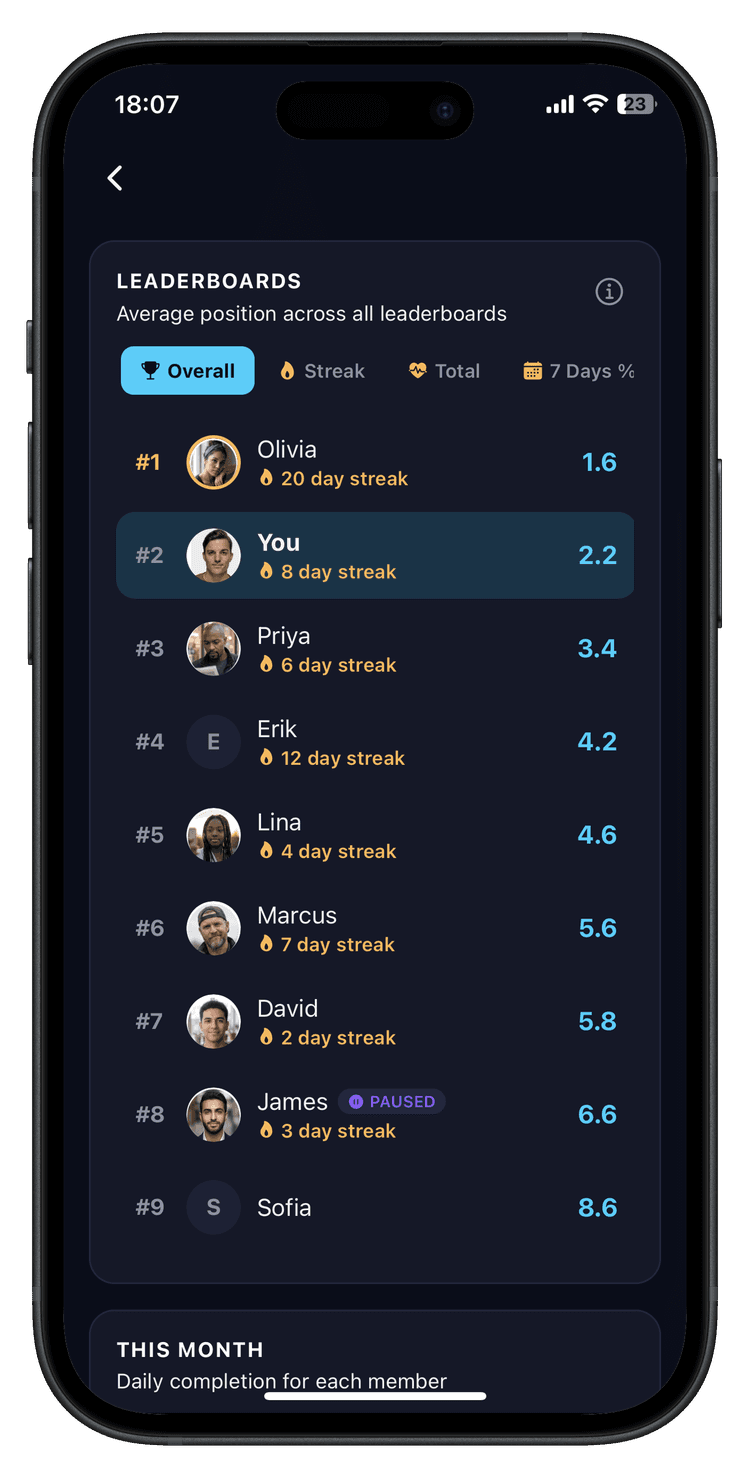
It works for two people as well as fifty; a two-person group is a partner setup with the admin removed.
Common questions
Does an accountability partner need the same goal as me? No. They need to check in reliably. Shared goals make conversation easier but aren't required — one of you running while the other writes works fine.
How often should we check in? Daily, if the habit is daily. Weekly check-ins let four bad days pass before anyone notices, which is usually enough to lose the habit entirely.
What if my partner stops responding? Address it once, directly, then convert to a group. Most partnerships end in silence rather than a conversation, and a group removes the single point of failure that caused it.
Can you pay someone to be an accountability partner? Yes — that's an accountability coach, typically $25–200/month depending on contact frequency. Worth it if nobody in your life will do it. We've compared the main services here.
Is an app better than just texting? Texting works until it doesn't. It fails at scale and it fails on the awkward day, because "did you go to the gym?" is a message most people won't send twice. An app removes the need to ask.

Ready to build habits with friends?
Start your 14-day free trial — no credit card required.